
Altcoin trading: advanced techniques
Master advanced altcoin trading techniques. Learn sector rotation, perpetuals, pair trading, narrative positioning, and risk management for traders.
Introduction
Picture two altcoin traders watching the same chart. SOL just broke a key resistance level on heavy volume. The first trader buys the breakout. The second waits, watches the order book, checks ETH/BTC, and scans the broader rotation. Two hours later, SOL is up 8%, then dumps 12%. The first trader is stopped out at a loss. The second never entered, and is now positioning into the next narrative.
The difference between holding altcoins and trading altcoins with skill is the difference between getting paid and being someone else's exit liquidity. Bitcoin trades on conviction. Altcoins trade on narrative, rotation, and regime. The rules are different, the timeframes are different, and the way capital flows is completely different. Most retail loses money in altcoins not because they pick bad assets, but because they apply Bitcoin-style thinking to a market that behaves nothing like Bitcoin.
This guide is for traders who already understand the basics and want the advanced techniques. Sector rotation. Pair trading against BTC and ETH. Leverage math that survives an altcoin volatility cycle. Liquidity awareness that keeps you out of bag-holding patterns. Risk management that scales with your book instead of getting wiped on the next 30% drawdown. By the end, you'll have a framework you can apply across any altcoin cycle, any narrative, and any market regime.
We'll cover the structural differences between altcoin and Bitcoin trading, the market hierarchy that determines where capital flows, the five-phase narrative cycle every sector goes through, advanced techniques like pair trading and perpetuals, the liquidity tax most traders pay without realizing, volatility regime detection, the 24/7 angle that compounds altcoin edge, and a six-rule risk framework that has more impact on your returns than any single trade idea ever will.
What separates altcoin trading from Bitcoin trading
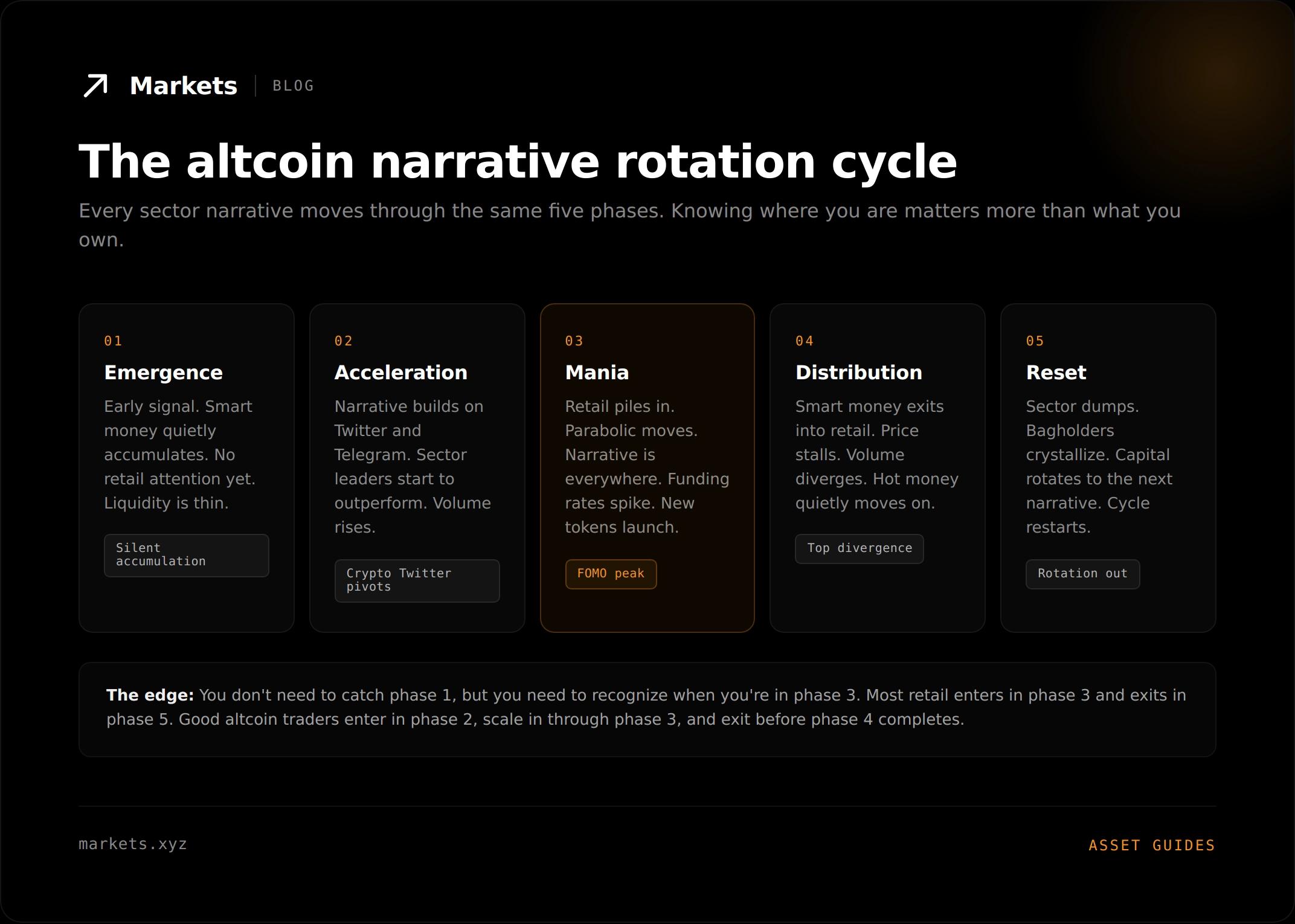
Bitcoin and altcoins live in the same broader market, but they trade on different rules. Bitcoin is a macro asset. Altcoins are sector bets. Conflate the two and you'll get stopped out on moves that should never have surprised you.
Higher beta to Bitcoin
Altcoins amplify Bitcoin's moves. When Bitcoin is up 5%, a major altcoin like SOL might be up 10%. A mid-cap might be up 20%. A meme might be up 60%. The amplification works in both directions. When BTC sells off 8%, the same altcoins are usually down 15%, 25%, and 45% respectively. Beta is the mechanism. Understand it before sizing any altcoin position.
The beta is not constant. In risk-on regimes, altcoins lead and BTC lags. In risk-off, BTC outperforms and altcoins absorb the bulk of the drawdown. The altcoin trader who reads regime correctly gets paid twice. The one who doesn't gets levered exposure to the worst direction.
Narrative-driven price action
Altcoins move on stories. AI tokens pump when AI is the dominant theme. RWA tokens pump when tokenized real-world assets are the focus. L2 tokens pump when L2 scaling is in the conversation. The fundamental value of any individual token matters less than which narrative is currently capturing attention and capital flow.
This is not a critique. It's how the market works. A trader who learns to read narratives early and exit before they peak has structural edge over one who picks assets based on fundamentals alone. Fundamentals matter for the long arc. Narratives drive the next three months.
Lower liquidity, wider spreads
Most altcoins have a fraction of Bitcoin's liquidity. Trading a $50,000 BTC position barely moves the price on a major venue. Trading a $50,000 position in a top-30 altcoin already shows up in the order book. Trading the same size in a small-cap can move the price several percent before your order even fills.
Spreads widen during volatility. The same altcoin that trades a 5 basis point spread during normal hours can show 50 to 100 basis points during a sector unwind. If you don't account for execution cost, you'll consistently overestimate your edge.
Faster regime changes
Bitcoin trends can persist for months. Altcoin sectors flip in days. An L2 narrative that was the entire conversation last week can be dead by Wednesday, replaced by the next theme. The trader who's holding the last narrative when rotation hits is the trader becoming bagholder for the new one's run.
This is why active management matters more in altcoins. Buy-and-hold can work on Bitcoin because the asset has a clearer long-term macro thesis. Holding an altcoin through a regime change requires a much stronger reason than simply hoping the previous narrative comes back. The market does not reward hope.
The altcoin market structure you need to understand
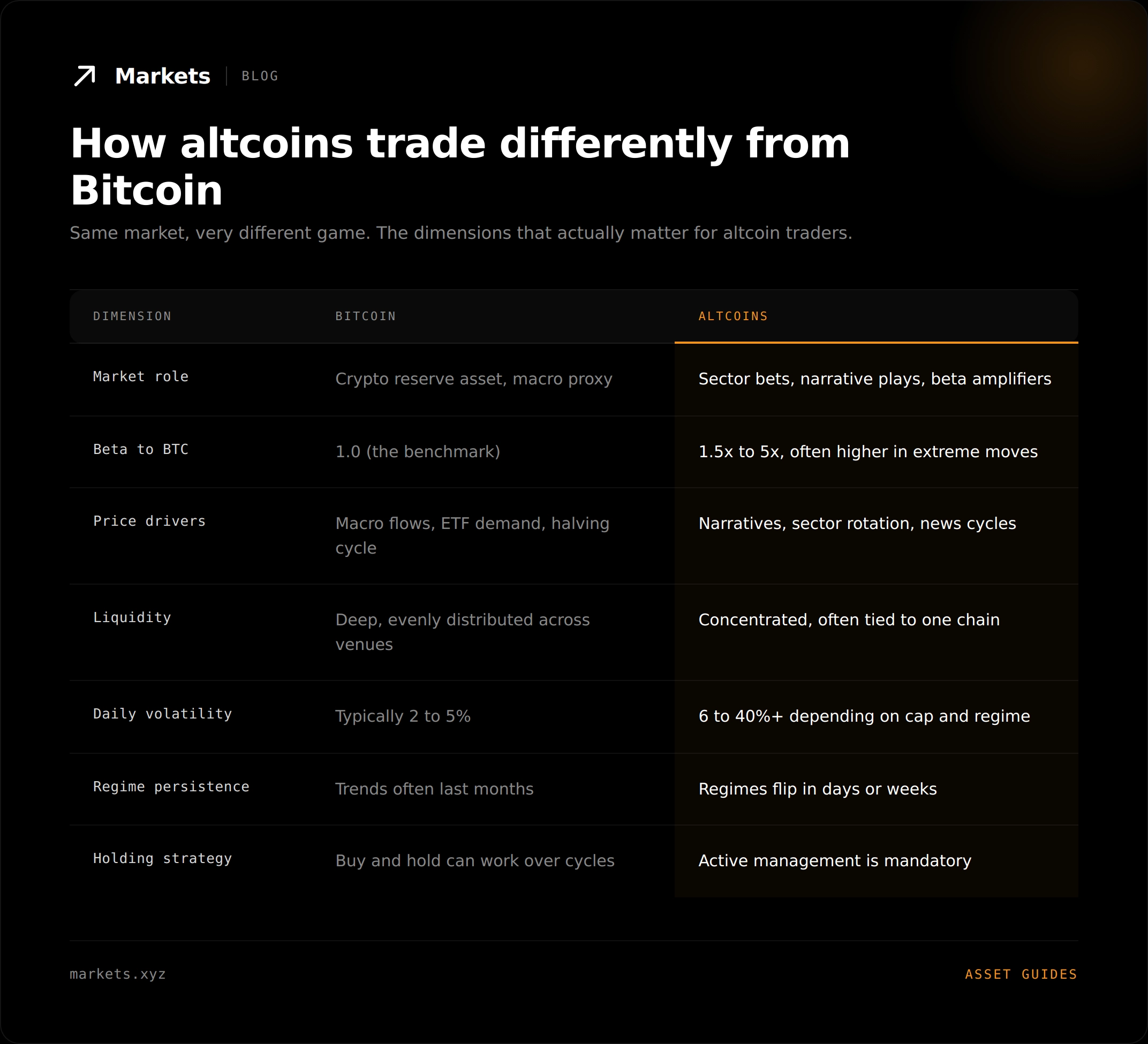
Capital in crypto often flows through a recognizable hierarchy. When new money enters the market, it usually goes to Bitcoin first. As risk appetite grows, it can rotate to Ethereum, then to major altcoins like SOL, BNB, XRP, and ADA, then to mid-cap narrative leaders, and eventually to meme coins and the long-tail. The sequence is not perfect in every cycle, but understanding where capital is flowing is often more important than understanding any individual token.
The BTC-ETH-altcoin capital flow hierarchy
Bitcoin sets the macro tone. When BTC dominance is rising, capital is consolidating into the safest crypto asset. When BTC dominance is falling, capital is rotating out, looking for higher beta exposure. The dominance chart is one of the most underused tools in altcoin trading.
Ethereum is still one of the main gateways into higher-beta crypto risk. ETH/BTC outperformance is often a strong signal that capital is moving down the risk curve, but it is not the only signal. In some cycles, SOL, majors, or specific narrative sectors can lead before ETH/BTC confirms. Watching ETH/BTC alongside BTC dominance, BTC/USD, and sector leaders gives you a more complete view of where you are in the cycle.
From ETH, capital cascades into majors, then narratives, then small caps. By the time meme coins are running, the cycle is usually closer to the end than the beginning. The traders who entered at the meme-coin phase are paying the ones who entered at the ETH-rotation phase.
Sector groupings
Altcoins are not a single asset class. They're a collection of sectors, each with its own internal dynamics. The main groupings are L1s (SOL, AVAX, competing base layers), L2s (Arbitrum, Optimism, Base ecosystem), DeFi (DEX tokens, lending protocols, derivatives platforms), AI tokens, RWA tokens, gaming and metaverse, and memes. Each sector trades on its own narrative and rotates on its own clock.
Trading the sector is often more efficient than trading the individual token. If AI is the dominant theme, multiple AI tokens will run together. Picking the single winner is hard. Holding two or three sector leaders with proper sizing captures the move without the single-token risk.
Liquidity tiers and what they mean for execution
Liquidity defines what trade size you can actually execute. A major like SOL or BNB can absorb mid-six-figure positions without meaningful slippage. A top-50 mid-cap might cap out at low-six-figures before execution becomes the trade's biggest cost. A small-cap can be untradeable in size, even if the thesis is right.
Match your trade size to the liquidity tier. The number on your screen is not the same as the number in your wallet after slippage and impact. Traders who ignore liquidity tiers consistently underperform their own backtests.
Reading altcoin narratives and sector rotation
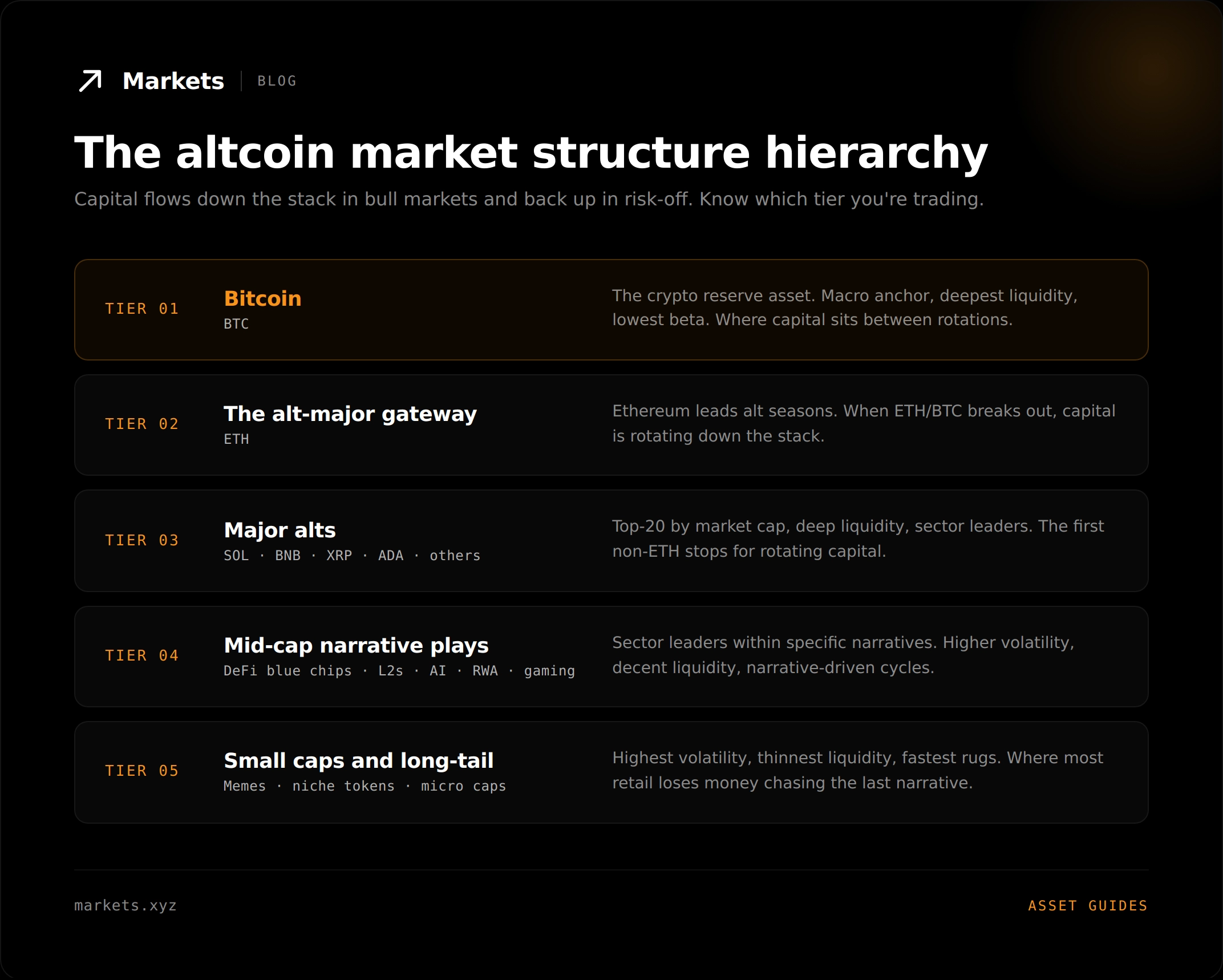
Every altcoin sector goes through the same cycle. Emergence, acceleration, mania, distribution, reset. The phases are the same whether the narrative is L1 competition, AI tokens, RWA, or whatever comes next. The only thing that changes is which sector is currently in which phase. Mapping that is the core skill of advanced altcoin trading.
How narratives form, accelerate, and dissipate
Narratives form in private. Smart money positions before the conversation starts. By the time a sector is the dominant theme on Crypto Twitter, the early phase is already over. Mid-cap leaders in the sector start outperforming majors. Volume moves up the chart. Funding rates start to rise.
Acceleration is where serious traders enter. The narrative is confirmed by price action across multiple tokens in the same sector. Liquidity is good. Volatility is high but the directional bias is clear. This is the phase where skilled altcoin traders make the bulk of their returns.
Dissipation is invisible while it's happening. Price keeps making new highs but volume diverges. The same tokens that led on the way up start to lag the broader sector. Funding rates stay elevated even on smaller pumps. The narrative is still everywhere on social media, but capital is already moving.
Mapping capital flow across a market cycle
In a full crypto cycle, capital typically rotates through three to five major sector narratives, each lasting a few weeks to a few months. The early rotation goes to ETH and majors. The mid rotation goes to large-cap sector leaders. The late rotation goes to small caps and memes. Then everything unwinds in reverse during the bear market.
The traders who outperform are the ones who recognize which phase of the broader cycle we're in and which sector phase each narrative is in. Holding majors in the late cycle and small caps in the early cycle are both common mistakes. Both leave returns on the table.
Recognizing when a narrative is over
The clearest signal a narrative is over is divergence between price and participation. New highs on lower volume. Sector leaders no longer leading. Funding rates that stay positive despite weakening price action. Sentiment that remains euphoric while market structure deteriorates.
The other reliable signal is the launch wave. When a narrative is peaking, new tokens launch trying to capture the remaining attention. Each new launch dilutes the available capital across more assets. By the third or fourth wave of launches in a sector, the original leaders are usually already topping out.
The next rotation is forming somewhere right now. The question is whether you're positioned for it or chasing the last one. Start trading on markets.xyz.
Pair trading: positioning altcoins against BTC and ETH
Pair trading is the technique most retail altcoin traders skip and most professionals depend on. Instead of asking whether SOL is going up, you ask whether SOL is going up faster than ETH. Instead of asking whether ETH is going up, you ask whether ETH is going up faster than BTC. Pair trades are how skilled altcoin traders express relative views without taking on full market beta.
The /BTC and /ETH denomination concept
Every altcoin can be priced against BTC, against ETH, or in USD. The same asset can be up against USD and down against BTC at the same time. Reading an altcoin chart in USD tells you what the market is doing. Reading it in BTC tells you whether the altcoin is actually outperforming its benchmark.
If SOL is up 10% in USD and BTC is up 12% in USD, SOL has actually underperformed BTC. The trader who only watches the USD chart misses this. The pair trader sees it immediately and adjusts. Most advanced altcoin views are expressed in BTC or ETH denomination, not USD.
When pair trading beats spot trading
Pair trades win when you have a relative view but no clear directional view. If you think SOL will outperform ETH but you're uncertain about overall market direction, going long SOL and short ETH expresses that view directly. If the market crashes, both legs lose money on the absolute side but SOL/ETH still moves in your favor if your thesis is right.
Pair trades also reduce variance. The dollar P&L of a pure altcoin long depends on both the altcoin's performance and the broader market's performance. The dollar P&L of a paired position depends only on the relative performance, which is usually a much steadier signal.
A practical pair trade example
Suppose you believe SOL will outperform ETH over the next month, based on the DeFi narrative shifting toward Solana ecosystem tokens. A pair trade would be to long SOL and short ETH in equivalent USD notional, say $10,000 on each leg. If SOL gains 15% and ETH gains 5%, you make 15% on the SOL leg, lose 5% on the ETH leg, for a net 10% return on capital deployed, regardless of whether the broader market went up, down, or sideways.
Compare to going naked long SOL with $20,000. Same dollar move on SOL produces a 15% gain on the position, but you're also exposed to whatever happens to the broader market. If BTC crashes 20% and drags everything with it, your SOL position can still lose money even if SOL outperformed ETH. The paired trade captures the relative thesis without the market beta exposure.
Using perpetuals and leverage on altcoins
Perpetual futures are the dominant trading instrument for altcoins, and leverage is their core feature. Used well, perps let you express directional views with precise sizing, hedge spot positions, and run pair trades without needing two physical positions. Used poorly, they turn into the fastest wealth destroyer in crypto.
Why altcoin perps behave differently than BTC perps
Altcoin perps trade with thinner books, wider spreads, more aggressive funding rates, and more violent liquidation cascades than BTC perps. A 5% wick on BTC is barely a blip. The same 5% wick on a small-cap altcoin perp can clear out the entire long book in seconds. The mechanics are the same. The volatility is not.
Liquidations on altcoin perps are also more correlated within sectors. When one L2 token gets liquidated cascade-style, the other L2 tokens often follow, because traders running sector-correlated books get cleared out together. This is why position-level risk and book-level risk both matter.
Funding rate dynamics on altcoins
Funding rates on altcoin perps swing harder than on BTC. During a strong move, funding can hit 0.1% or more per 8-hour period, which annualizes to over 100%. Holding a leveraged long through extended high funding is paying a tax that compounds against you, often more than any drawdown the position itself would experience.
Read funding before entering. Extreme positive funding usually means the long side is crowded and a flush is likely. Extreme negative funding means the short side is crowded and a squeeze is likely. Funding is a sentiment indicator as much as a cost line.
Liquidation risk multiplied
The same 10x leverage means very different things on different altcoins. On BTC, 10x gives you roughly a 9.5% liquidation distance, which is comfortable against a typical daily move. On a major altcoin with 8% daily volatility, that same 9.5% can be hit in a single session. On a small-cap with 30% swings, you're effectively guaranteed to be liquidated.
Effective max leverage on altcoins is much lower than the nominal max the platform offers. Just because you can use 50x doesn't mean you should. For majors, 2x to 3x is often the sustainable max. For smaller alts, 1x to 2x is the realistic ceiling if you want to hold through any meaningful timeframe.
Sizing positions for altcoin volatility
Volatility-adjusted sizing is the practice of scaling position size inversely to expected volatility. A position in BTC at 4% volatility and a position in a high-beta altcoin at 16% volatility should not be the same dollar size. The high-volatility position should be roughly one quarter the size to keep the expected drawdown contribution similar.
This rule alone separates traders who survive multiple cycles from traders who blow up in one. If every position is sized to a target volatility contribution, no single position can take out your book. If positions are sized by dollar amount instead, one high-vol altcoin position can offset gains from ten major positions in a single bad week.
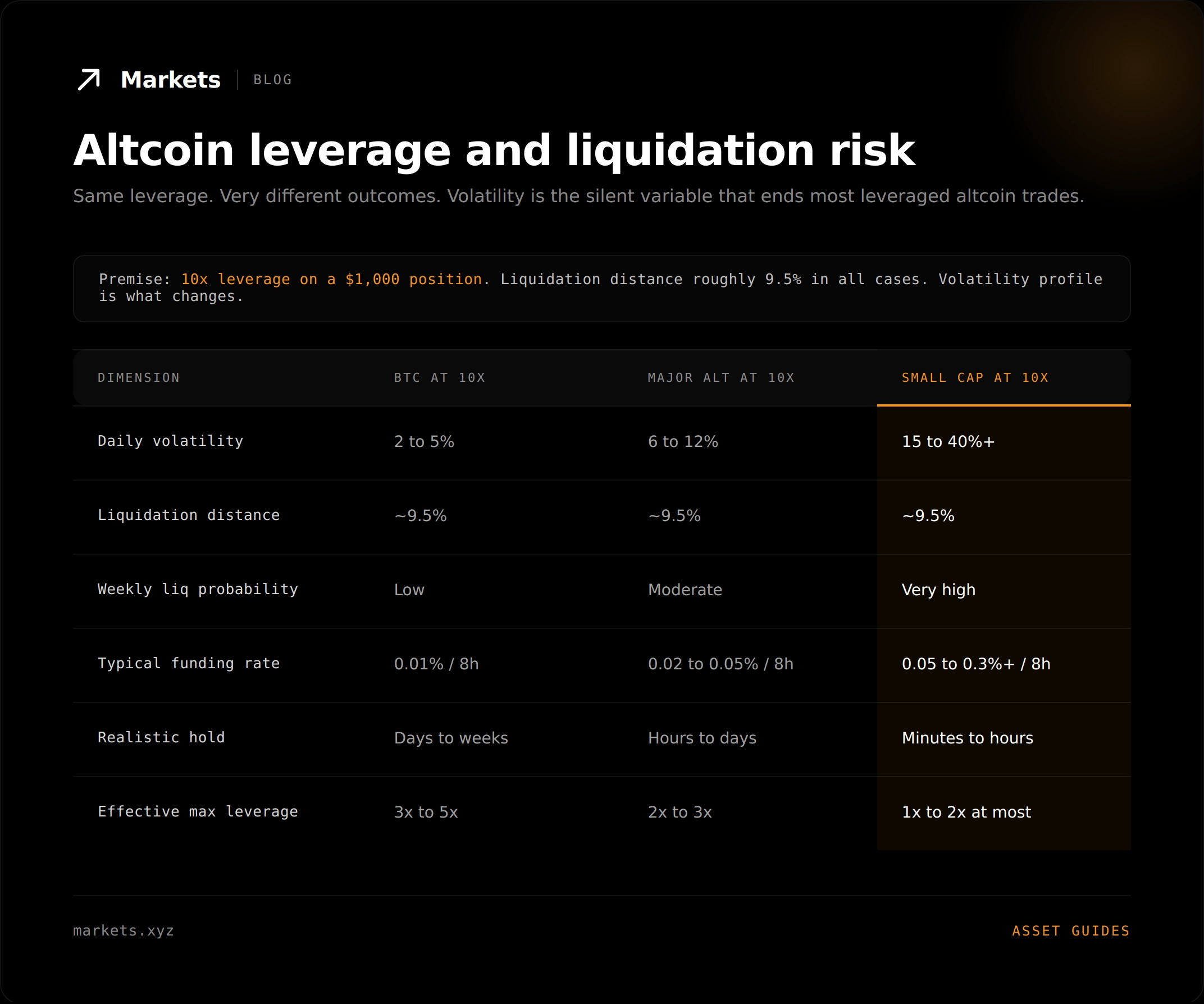
Leverage warning: On altcoins, the leverage your platform allows is rarely the leverage you should use. Effective max leverage is bounded by volatility, not by what the interface offers. Scale leverage down as you move from BTC to majors to mid-caps to small caps. The trader who survives is the one who underuses leverage when others are pushing it to the limit.
Trade altcoin perpetuals with self-custody, 24/7 access, and no exchange-controlled account. Start trading on markets.xyz.
Liquidity and execution: the hidden tax on altcoin trades
Most altcoin trading guides skip execution. That's a mistake. The difference between a profitable strategy and an unprofitable one on the same exact signals is often just execution quality. Slippage, spread, and fees compound across every trade in your career. Ignore them and your real returns will always trail your backtest.
Slippage scales with cap and trade size
Slippage is the difference between the price you expected and the price you actually got. For a major altcoin in normal conditions, slippage on a reasonable trade size might be a few basis points. For a mid-cap in a volatile market, the same trade can slip 50 to 100 basis points. For a small-cap during a sector unwind, slippage can exceed 5%.
Slippage is a tax that scales with your size and the asset's illiquidity. Cut your trades into smaller pieces, use limit orders where you can, and avoid market orders in low-liquidity windows. The execution improvement compounds over a year more than most traders realize.
Order book depth analysis
Before entering any altcoin position, look at the order book. Specifically, look at the size available at the first five price levels above and below the current price. If your intended position size is larger than the depth available at the first three levels, you're going to move the market, and the trade is going to cost you more than the chart suggests.
Depth varies dramatically by hour. Asian session and US morning are usually the deepest for major altcoins. Late US session and early European session are usually the thinnest. Plan your entries and exits around when the book is actually deep enough to absorb your size without impact.
Limit versus market orders
Market orders prioritize speed over price. They fill instantly at whatever the book offers. Limit orders prioritize price over speed. They fill only at your specified price or better. For most altcoin trades, limit orders are the right default. The fill rate is usually high if your limit is reasonable, and you save the spread on every trade.
The exception is when you need to be in or out immediately, typically during fast-moving news or breakouts. Then market orders are correct, but accept the execution cost as the price of speed. Mixing the two without intent is expensive. Pick the right tool for each situation and stick to it.
Avoiding the bagholder pattern
Bagholding happens when illiquid exits prevent you from getting out of a losing position at the price you expected. By the time you decide to sell, the bid stack is empty and your sell order walks the book down by 10 or 20%. You either accept the bad execution or hold longer hoping for liquidity that may never come.
Avoid the bagholder pattern by checking exit liquidity before you enter. If the book is too thin to support your exit, the position is too big for the asset. Always trade with the assumption that exits will be worse than entries, especially in small caps. Plan your size with the worst-case exit in mind.
Volatility regimes and position sizing
Markets cycle through volatility regimes. Low volatility means tight ranges, small daily moves, and slow trend development. Mid volatility means active trends and clear setups. High volatility means wide swings, fast reversals, and liquidation cascades. Each regime requires different sizing, different stop placement, and different expected hold time.
Identifying low, mid, and high volatility regimes
The simplest regime indicator is average true range (ATR) as a percentage of price. Below 3% daily is low volatility. 3 to 8% is mid. Above 8% is high. These thresholds vary by asset, but the framework is universal. Track ATR for the altcoins you trade. Know which regime each one is in before sizing any position.
Adjusting size based on regime
If your standard position size assumes mid volatility, adjust up in low regimes and down in high regimes. A useful rule of thumb is to scale inversely. Half the volatility means double the size. Double the volatility means half the size. This keeps expected drawdown per position roughly constant across regimes.
Stop placement in volatile conditions
Stops in high volatility need to be wider than in low volatility, or they will be hit on noise. But wider stops mean smaller position size to keep risk constant. The combination of wider stops and smaller positions is the right answer in high volatility, not just one or the other.
A common mistake is keeping stop distances tight while keeping position size the same as in mid volatility. The result is that random intraday noise stops you out on positions that would have worked over a slightly longer horizon. Wider stops with smaller positions give you the same total risk and much higher hit rate.
The 24/7 advantage for altcoin traders
Altcoins are the original 24/7 market. Major moves often happen outside Western business hours: Asian session pumps, weekend rotations, overnight news cycles, and sudden liquidation cascades. The edge is not just having markets open. It is having reliable access, execution, risk controls, and the ability to adjust positions whenever the move happens.
Altcoin moves cluster in non-Western hours
A meaningful share of altcoin volatility happens during Asian trading hours, which corresponds to late evening US time. By the time a US-only trader wakes up to check the market, many setups have already played out. The trader with 24/7 platform access can participate, the trader without it can only watch.
Weekend pumps, dumps, and overnight reversals
Weekend price action in altcoins is some of the most active of the entire week. Lower liquidity combined with active retail participation often produces the biggest moves of the cycle. Some traders only trade weekends specifically because the inefficiencies are highest when institutional activity is lowest.
Holding altcoin positions through a weekend on a closed platform is taking directional exposure to events you cannot trade around. On a 24/7 platform, the weekend is just more trading hours, with the same access and the same tools as a Tuesday afternoon.
News-driven catalysts outside business hours
Major altcoin catalysts rarely respect business hours. Protocol announcements, exploits, partnership news, regulatory commentary, and exchange listings all drop at unpredictable times. The trader who can position immediately captures the move. The trader who has to wait for their platform to open captures the regret of watching it from the chart.
Risk management techniques specific to altcoins
Risk management is the single largest determinant of long-term altcoin trading returns. More than asset selection, more than timing, more than any single strategy. The traders who survive multiple cycles are the ones who treat risk discipline as the actual edge, with everything else as tactical execution on top of that base.
The 1% rule and why it matters more for alts
A common risk framework is to risk no more than 1% of total trading capital on any single altcoin trade. This means the maximum planned loss from your stop, not the position size. A $100,000 book risking 1% would risk $1,000 on the trade. With a 5% stop, that implies a $20,000 position. With a 10% stop, $10,000. Sizing follows risk, not the other way around.
The 1% rule matters more on altcoins than on BTC because altcoin trades have lower win rates and wider drawdowns. A trader who risks 5% per altcoin trade needs only four consecutive losers to lose 20% of their book. At 1% risk, the same four losers cost 4%. Math compounds. So does undisciplined sizing.
Correlation risk across your altcoin book
Three different L2 tokens are not three different trades. They're one sector bet with three legs. When the L2 narrative unwinds, all three positions move together. A book of ten altcoins from five different sectors has real diversification. A book of ten altcoins all from the AI narrative has none.
Track exposure by sector, not just by name. Many traders cap total exposure to any single sector so a sector-wide unwind cannot take out a disproportionate share of capital. Real diversification is across uncorrelated narratives, not across tokens that all move together.
Stablecoin reserves and the exit plan
Hold a baseline reserve in stables. For many traders, keeping a meaningful cash buffer is what allows them to size up when the next narrative emerges. Cash is not a sign of weakness or missed opportunity. It is the ability to act when the market gives you a better setup. Traders who are always fully deployed are always reacting. Traders with reserves are positioning.
The exit plan should be defined before the trade is entered, in writing. Where do you take partial profits? Where do you exit completely? Where is the stop? If you have to make these decisions while the trade is moving, you'll make them badly. The market exists to extract money from traders who improvise.
When to cut, when to scale out
Cut losers fast. The signal that a thesis is wrong is the price moving against you with no improvement over your defined timeframe. Hesitation here is the biggest source of avoidable losses in altcoin trading. The pain of cutting at a small loss is real but small. The pain of holding through a 40% drawdown trying to break even is much larger.
Scale out of winners. Take partial profits at predefined targets and let the rest run with a trailing stop. Scaling out captures most of the meat of a big move while protecting against the inevitable reversal. The trader who tries to exit perfectly at the top usually exits at neither the top nor a profit.
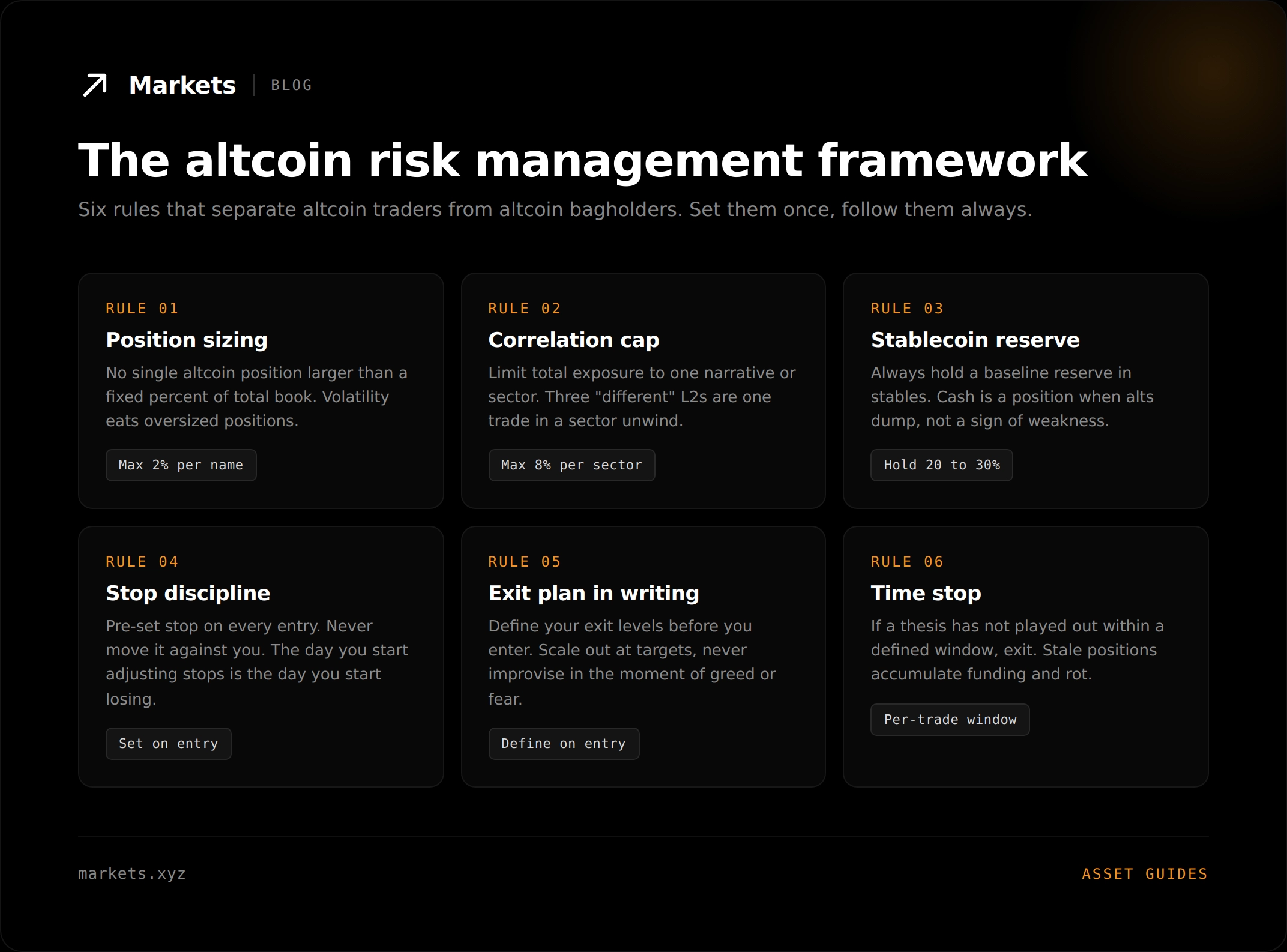
Risk discipline: The biggest difference between altcoin traders who compound for years and altcoin traders who blow up in months is not skill, asset selection, or timing. It's whether they treat their own risk rules as inviolable. Rules you sometimes follow are just suggestions. Suggestions are the market's favorite kind of trader.
How Markets.xyz delivers for altcoin traders
Markets.xyz brings together a trading terminal, mobile trading app, and HIP-3 deployer built on Hyperliquid infrastructure. Hyperliquid provides the trading-specific Layer 1, on-chain order-book infrastructure, and fast settlement layer. HIP-3 allows deployers like Markets to launch and operate new perpetual markets on top of that infrastructure.
For altcoin traders, that means access to supported perpetual markets through a product layer designed for active trading. Orders and positions are handled through Hyperliquid infrastructure, while Markets provides the interface, market access, and trading experience. The result is self-custodial trading without relying on a centralized exchange account.
Asset coverage includes major crypto markets like BTC, ETH, SOL, and other supported perpetuals, alongside additional markets deployed through the broader stack. Trading is available 24/7, with funding, oracle design, and liquidity depending on the specific market. Access is available across supported jurisdictions, with no KYC required where Markets.xyz is available.
You can see the model in action by trading supported altcoin perpetuals directly. SOL, ETH, and other supported contracts trade continuously, including weekends and after-hours. Liquidity can still vary by session and market conditions, but the platform access and trading infrastructure remain available when the move happens.
Trade altcoins like the pros. Self-custody, 24/7, no KYC. Start trading on markets.xyz.
When not to trade altcoins
Most altcoin underperformance comes from trading altcoins in the wrong regime. The skill of not trading is undervalued. Periods exist when the expected return on altcoin trading is negative regardless of asset selection or strategy. Recognizing those periods and stepping back is one of the most valuable habits a trader can build.
Chop markets are the first signal to reduce. When price is ranging without trend across most altcoins, mean-reversion strategies work but trend strategies bleed. If your edge is trend-following and the market is choppy, your edge is temporarily zero. Forcing trades during these periods is the fastest way to give back the gains from real trending phases.
Macro overlay also matters. When the Fed is hiking aggressively, when equity markets are in clear risk-off mode, when DXY is breaking out, altcoins as a category struggle. A trader who insists on running long altcoin exposure through these periods is taking macro risk that has nothing to do with individual altcoin theses.
The FOMO trap is the third pattern. When a sector has already had its mania phase, the urge to chase the late move is at its strongest. Most traders enter the sector at this exact point and become the exit liquidity for the people who entered in acceleration. If the move is parabolic and the chart looks too good to miss, the smart move is almost always to not enter.
Discipline check: The best altcoin traders are not the ones who are always in a position. They're the ones who only take positions where their edge is clearly present. Sitting in cash through a chop market is not weakness. It's the highest form of risk management.
Frequently asked questions
Common questions advanced altcoin traders ask, answered without the marketing gloss.
What's the actual difference between altcoin trading and Bitcoin trading? Bitcoin trades on macro flows and acts as the crypto reserve asset. Altcoins trade on narratives, sector rotation, and beta to Bitcoin. The instruments are similar but the drivers, timeframes, and required skills are fundamentally different. Applying Bitcoin-style buy-and-hold to altcoins is one of the most common ways traders give back their gains.
Are altcoins always riskier than Bitcoin? On a per-trade basis, yes. Higher beta, lower liquidity, and faster regime changes all increase risk. But a well-managed altcoin book with proper sizing and correlation discipline can compound at higher returns than Bitcoin alone, especially during alt season. The risk premium is real and so is the return premium if you trade them well.
How much leverage should I use on altcoins? Far less than the platform allows. For majors like SOL or BNB, 2x to 3x is often the realistic ceiling for any meaningful hold time. For mid-caps, 1x to 2x. For small caps and memes, spot is usually the right answer. The platform lets you use 50x because regulators do not prevent it, not because it's a sensible choice.
How do I identify which altcoin narrative is starting? Watch sector leaders for relative strength against Bitcoin and Ethereum. A narrative is starting when multiple tokens in the same sector are outperforming the broader market on rising volume. Crypto Twitter usually confirms a narrative a week or two after price action does. The earlier signal is in the chart.
Should I trade altcoin spot or perpetuals? Depends on your strategy. Spot is simpler, has no funding cost, and works best for longer holds and lower-velocity trading. Perpetuals offer leverage, shorting, and capital efficiency, and are usually better for active trading and pair trades. Most advanced traders use both, with spot for core positions and perpetuals for tactical trades and hedges.
How do I avoid getting stuck in a dead altcoin? Define your exit before entering. Use a time stop alongside a price stop. If the thesis has not played out in the defined window, exit regardless of current price. The cost of exiting a stale position is far lower than the cost of holding it through the next sector unwind.
Is altcoin trading viable in bear markets? Yes, but the rules change. In bear markets, the dominant flow is out of altcoins and back into Bitcoin and stables. Long altcoin strategies underperform badly. Short altcoin and pair-trade strategies, where you express relative views without directional exposure, can still produce returns. Adjust your strategy to the regime or reduce your activity.
Conclusion
Altcoin trading rewards skill, not enthusiasm. The traders who compound for years are the ones who treat market structure, narrative rotation, volatility regime, and risk discipline as the foundation. Strategy and asset selection are tactical layers on top of that base. Skip the foundation and the layers do not hold up.
The advantages are concrete. Sector rotation captures returns the spot-only trader leaves on the table. Pair trading expresses relative views without carrying full market beta. Perpetuals enable shorting and hedging that spot cannot. 24/7 access lets you act on catalysts when they actually happen. Risk management compounds over a career in ways that any single strategy cannot.
The market does not reward conviction without process. It rewards traders who know when they have edge, when they do not, and when the best trade is no trade. Build the process. Apply it. Trade what you can actually edge, sit out what you cannot, and let the math compound.
The market rewards skill, not timing alone. Trade altcoins on infrastructure built for serious traders. Start trading on markets.xyz.
Risk disclaimer: Trading altcoins involves substantial risk, including the possible loss of principal. Altcoin markets are more volatile and less liquid than Bitcoin or traditional asset markets, and price moves can be rapid and extreme. Leverage amplifies both gains and losses. Past performance is not indicative of future results. Markets.xyz is not available to residents of the United States, the United Kingdom, or the province of Ontario in Canada. Full terms, conditions, and risk disclosures are available at markets.xyz. Information in this article is for educational purposes only and does not constitute financial, investment, or trading advice.