.webp&w=3840&q=75)
Bitcoin trading guide 2026: how to trade BTC 24/7 on a decentralized platform
Learn how to trade BTC on Marketz.xyz
Introduction
Bitcoin is the most traded, most discussed, and most recognized digital asset on the planet. It's also one of the most misunderstood when it comes to actually trading it. Most people know what Bitcoin is. Far fewer know how to trade it effectively, how to manage risk in a volatile market, or how to access the full range of instruments available to sophisticated BTC traders in 2026.
This guide covers all of it. From the fundamentals of what drives Bitcoin's price, to spot trading vs. perpetual futures, to leverage strategies, risk management, and how to trade BTC around the clock on a decentralized platform with no geographic restrictions and no closing time.
Whether you've never placed a Bitcoin trade or you're moving from a centralized exchange to a decentralized platform for the first time, this guide gives you everything you need to trade BTC with confidence in 2026.
What is Bitcoin and why does it trade differently?
Bitcoin (BTC) is a decentralized digital currency created in 2009 by the pseudonymous Satoshi Nakamoto. It operates on a peer-to-peer network secured by cryptographic proof of work, with no central authority controlling its issuance or transactions. There will only ever be 21 million Bitcoin in existence, making it the first digitally scarce asset in history.
That scarcity, combined with global accessibility and 24/7 availability, makes Bitcoin trade very differently from traditional assets like stocks or commodities.
Key characteristics that drive BTC price action
Fixed supply with predictable issuance. New Bitcoin is created through mining, and the rate of new supply is cut in half roughly every four years in an event called the halving. The most recent halving occurred in April 2024, reducing block rewards from 6.25 BTC to 3.125 BTC per block. Historically, halvings have preceded significant bull markets as new supply constricts while demand continues to grow.
Global 24/7 market. Unlike stocks, Bitcoin trades at all hours across every time zone. This means price-moving events, whether a regulatory announcement, a macroeconomic shock, or a large on-chain transaction, can cause significant moves at any time of day or night. Traders on traditional platforms often wake up to gaps they cannot act on. On a 24/7 platform like Markets.xyz, you're always positioned to respond.
High volatility with deep liquidity. Bitcoin's daily price swings of 3 to 10% are common, and moves of 20 to 30% over short periods occur regularly during key market events. This volatility creates significant trading opportunity in both directions, long and short, which is why perpetual futures have become the dominant instrument for professional BTC traders.
Macro sensitivity. In 2026, Bitcoin is increasingly correlated with broader risk appetite. Federal Reserve policy decisions, inflation data, dollar strength, and global liquidity conditions all influence BTC's price alongside crypto-native catalysts. Understanding both the macro environment and on-chain fundamentals gives traders a genuine edge.
Spot trading vs. perpetual futures: which is right for you?
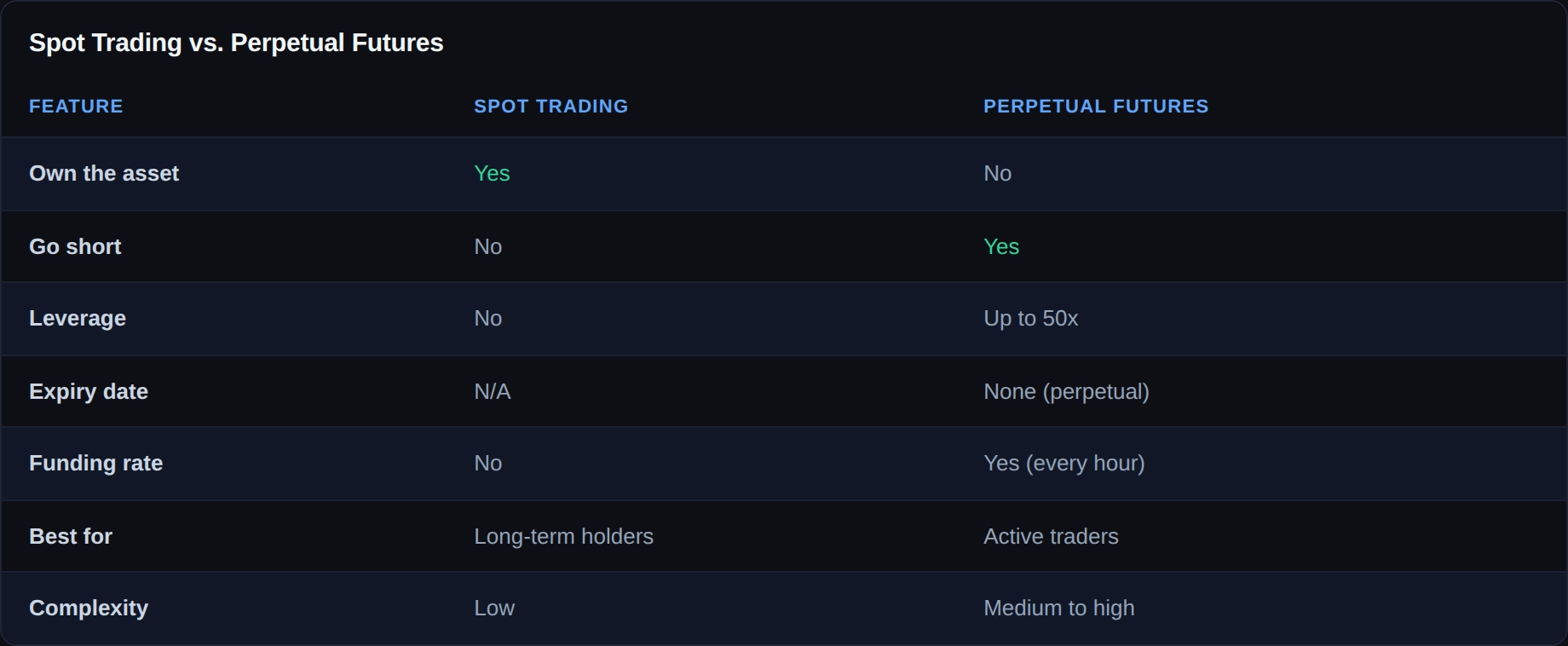
There are two primary ways to trade Bitcoin: buying it directly on the spot market, or trading it as a perpetual futures contract. Both have their place depending on your goals, time horizon, and risk tolerance.
Spot trading
When you buy Bitcoin on the spot market, you are purchasing actual BTC at the current market price. You own the asset. If the price goes up, you profit. If it goes down, you lose. Spot trading is straightforward and is the right choice for traders who want direct exposure to Bitcoin's long-term price appreciation without the complexity of derivatives.
Markets.xyz supports spot trading via Hyperliquid Builder Codes, giving you direct digital asset trading alongside the full suite of perpetual futures instruments on a single unified platform.
Perpetual futures
Perpetual futures (perps) are the dominant trading instrument for active Bitcoin traders. A BTC perpetual contract tracks the price of Bitcoin without you ever needing to own the underlying asset. Key advantages include the ability to go short (profit when price falls), access to leverage, and the ability to hold positions indefinitely with no expiry date.
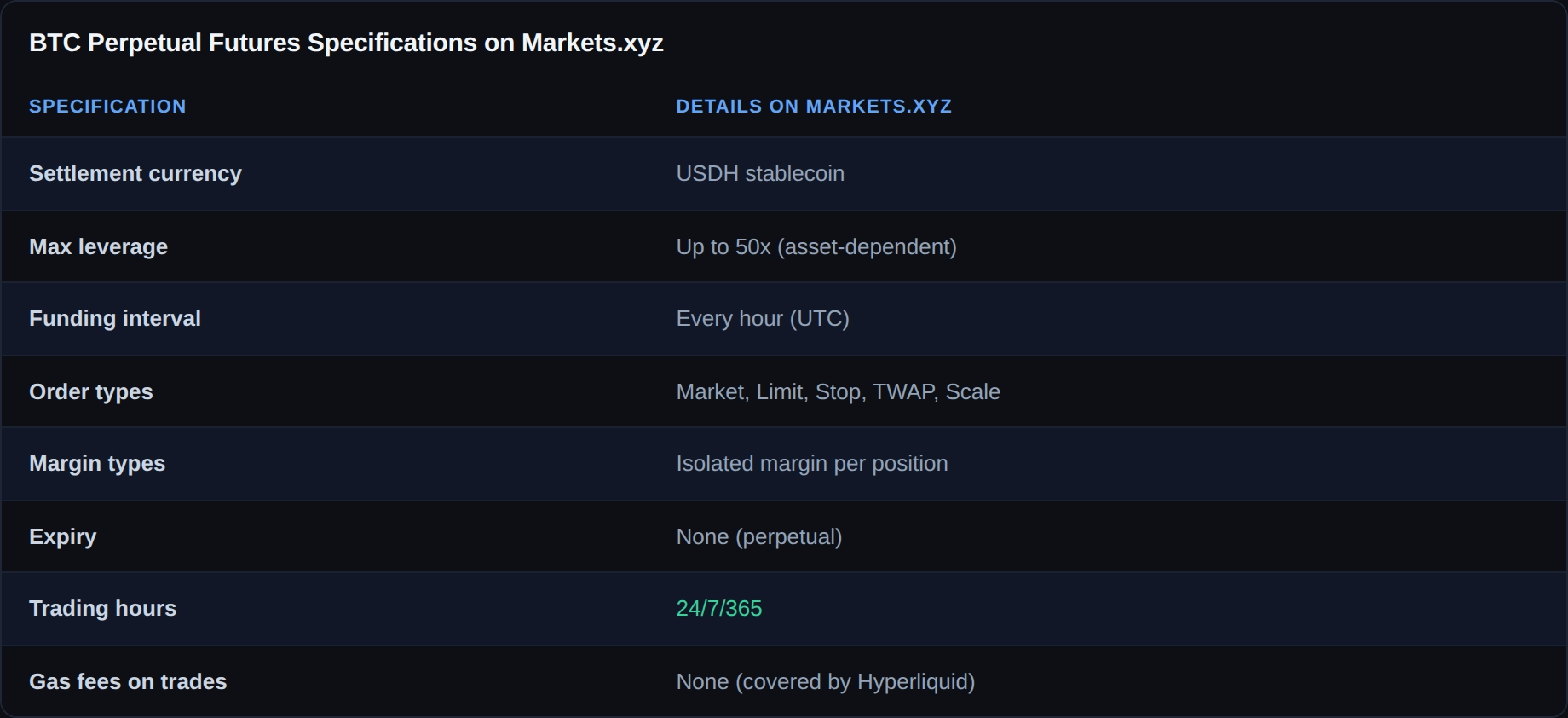
On Markets.xyz, BTC perpetuals are available 24/7 with up to 50x leverage, USDH margining, and near-instant settlement via Hyperliquid's HyperBFT consensus. This means you can open, manage, and close BTC positions at any time with no delays, no settlement risk, and no counterparty holding your funds.
Trade Bitcoin 24/7, no closing time, no gatekeepers. Start trading on markets.xyz.
How Bitcoin perpetual futures work
If you're new to perpetuals, this section covers everything you need to understand before placing your first BTC perp trade.
The basics: long and short
When you open a long position on a BTC perpetual, you are betting that Bitcoin's price will rise. If it does, you profit. If it falls, you lose. A short position is the opposite: you profit if Bitcoin's price falls and lose if it rises. This two-directional nature is one of the most powerful features of perpetual futures, giving you the ability to generate returns in both bull and bear markets.
Leverage and margin
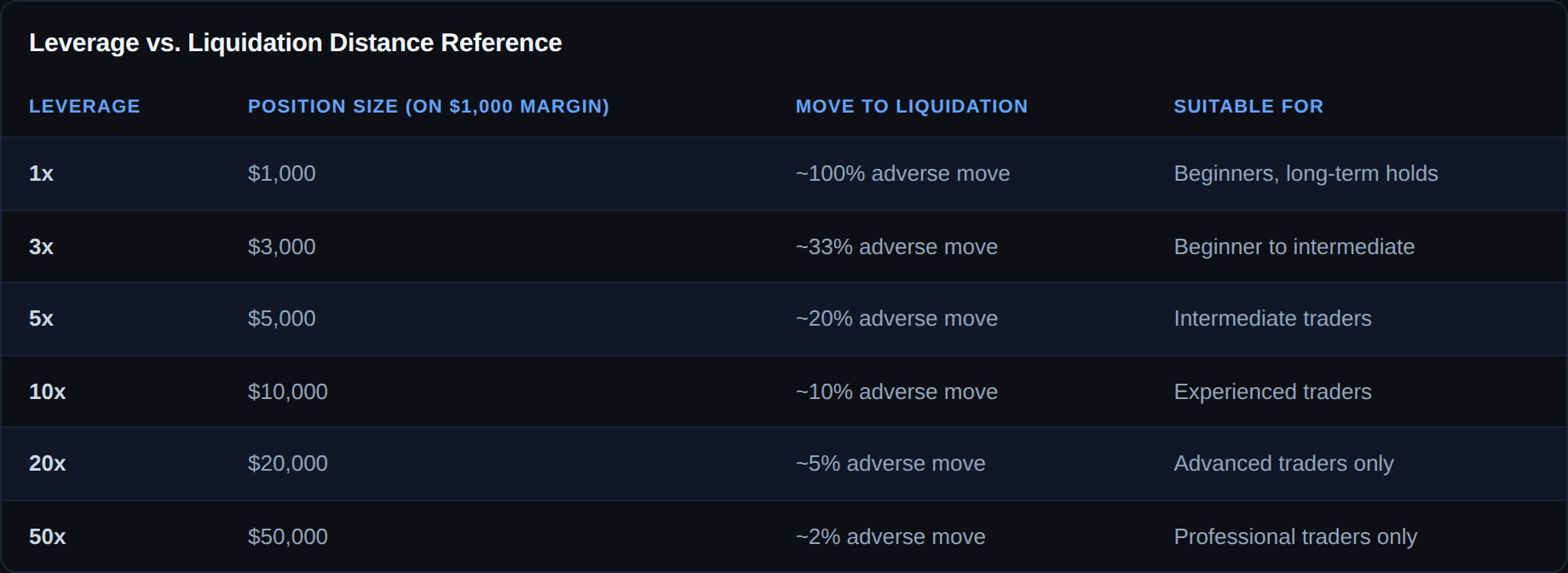
Leverage allows you to control a position larger than your deposited capital. On Markets.xyz, BTC perpetuals support up to 50x leverage. This means a $1,000 deposit can control a $50,000 BTC position.
Leverage warning: While leverage amplifies your gains, it equally amplifies your losses. A 2% move against a 50x leveraged position results in a 100% loss of your margin. Always size your leverage to your risk tolerance and never use maximum leverage unless you are an experienced trader with robust risk management in place.
Margin is the collateral you deposit to open and maintain a leveraged position. On Markets.xyz, all positions are margined in USDH, a stablecoin that ensures your margin value doesn't fluctuate with the market while your position is open. Isolated margin lets you ring-fence risk to individual positions, so one bad trade doesn't affect your entire portfolio.
Funding rates
Because perpetual futures have no expiry, a mechanism called the funding rate keeps the perpetual price anchored to the underlying Bitcoin spot price. Every hour on Markets.xyz, a small payment is exchanged between long and short holders:
• When the perpetual trades at a premium to spot (more demand to be long), longs pay shorts
• When the perpetual trades at a discount to spot (more demand to be short), shorts pay longs
Funding rates are displayed clearly on the platform before you open any position. They are typically very small (fractions of a percent per hour) but can widen significantly during periods of high market excitement. Long-term position holders should monitor funding costs as part of their overall trade economics.
Liquidation
If your position moves against you to the point where your margin balance can no longer cover the loss, your position will be liquidated automatically. The liquidation price is displayed on the platform when you open a trade. To avoid liquidation, always use stop-loss orders and never risk more margin than you can afford to lose entirely.
What moves Bitcoin's price: a trader's framework
Understanding what drives BTC price action is as important as understanding the mechanics of the instruments you trade. Here are the key factors every Bitcoin trader should track in 2026.
Macro and monetary policy
Bitcoin has become increasingly sensitive to global monetary conditions. When central banks signal looser policy (lower rates, quantitative easing), risk assets including Bitcoin tend to rally as investors seek higher-returning assets. When policy tightens, the opposite often occurs. Federal Reserve meeting dates, inflation data releases, and US dollar strength are all important signals for BTC traders to monitor.
Bitcoin halving cycle
The April 2024 halving reduced BTC's annual inflation rate to below 1%, making it more scarce than gold on a stock-to-flow basis. Historically, the 12 to 18 months following a halving have been among the strongest periods for Bitcoin price appreciation. Traders who understand where we are in the halving cycle have a useful macro framework for longer-term directional bias.
On-chain metrics
Bitcoin's blockchain is fully public, giving traders access to real-time data that simply doesn't exist for traditional assets. Key on-chain metrics to monitor include exchange inflows and outflows (large inflows can signal selling pressure), miner behavior, long-term holder accumulation patterns, and the MVRV ratio (market value to realized value, a measure of whether the market is overextended).
Institutional flows
The approval of spot Bitcoin ETFs in the US in early 2024 brought a wave of institutional capital into the BTC market. Weekly ETF flow data is now a closely watched indicator. Large inflows suggest institutional demand is growing; outflows can signal near-term bearish sentiment from the same cohort.
Regulatory developments
Regulatory news continues to be a significant driver of short-term Bitcoin price volatility. Positive developments, such as clearer regulatory frameworks or government adoption of Bitcoin, tend to trigger rallies. Negative news, such as exchange bans, tax crackdowns, or enforcement actions, can cause sharp selloffs. Traders who follow regulatory news across multiple jurisdictions, not just the US, have a real informational edge.
Market sentiment and fear and greed
Bitcoin is famously sentiment-driven. The Crypto Fear and Greed Index, which aggregates volatility, market momentum, social media, and other signals into a single 0 to 100 score, is a widely followed contrarian indicator. Extreme fear (below 20) has historically corresponded with buying opportunities. Extreme greed (above 80) has often preceded corrections.
Bitcoin trading strategies for 2026
The following strategies are suited to different experience levels, time horizons, and risk tolerances. The best strategy is the one you can execute consistently with discipline.
1. Trend following
Bitcoin has a strong tendency to trend, sometimes for weeks or months at a time. Trend following involves identifying the direction of the dominant trend using moving averages, higher highs and higher lows (uptrend), or lower highs and lower lows (downtrend), and trading in the direction of that trend until it shows signs of exhaustion. On a 24/7 platform, trend trades can be entered and managed at any time, including during the Asian session when major moves often begin.
2. Breakout trading
Bitcoin frequently consolidates in a tight range before making a large directional move. Breakout traders identify key resistance levels (price ceilings the market has repeatedly failed to break through) and support levels (floors the market has repeatedly bounced from), then enter positions when price breaks convincingly through one of these levels with strong volume. False breakouts are common, so confirmation is important before committing full position size.
3. Range trading
When Bitcoin is not trending, it often oscillates between a clear support level and a clear resistance level. Range traders buy near support and sell (or short) near resistance, capturing the predictable oscillation between the two boundaries. This works best during lower-volume periods such as weekends or the overnight session when momentum is limited. The key risk is a breakout from the range, which is why stop-losses just outside the range boundaries are essential.
4. News and event-based trading
Bitcoin reacts sharply to high-impact news: Federal Reserve decisions, ETF flow data, exchange hacks, regulatory announcements, and large on-chain movements. Event traders position themselves ahead of known catalysts (like scheduled Fed meetings or Bitcoin protocol upgrades) or react quickly when unexpected news hits. A 24/7 platform is essential for this strategy because the most important crypto news often breaks outside traditional market hours.
5. Dollar-cost averaging (DCA) on spot
For traders who believe in Bitcoin's long-term value but want to reduce the risk of buying at a single price point, DCA is the most reliable accumulation strategy. You invest a fixed amount at regular intervals regardless of the current price. Over time, you buy more BTC when prices are low and less when they are high, averaging your cost basis toward a favorable level. A 24/7 platform lets you schedule DCA purchases at any time that suits your cash flow cycle.
6. Shorting Bitcoin during bear markets
One of the most powerful advantages of perpetual futures is the ability to profit when prices fall. During confirmed downtrends, experienced traders use short positions to generate returns even as the broader market declines. Key signals for a shorting setup include a breakdown below a major support level, bearish divergence on RSI or MACD, and increasing exchange inflows (holders moving BTC to exchanges often signals intent to sell). Shorting requires disciplined risk management as Bitcoin can spike sharply even during downtrends.
Long, short, spot, or perpetuals. Markets.xyz gives you every tool to trade Bitcoin your way, 24/7. Start trading on markets.xyz.
Technical analysis for Bitcoin traders
Technical analysis (TA) is the study of price charts and trading volume to forecast future price movements. It's the primary toolkit of most active Bitcoin traders. Here are the most widely used tools and how to apply them to BTC.
Moving averages
Moving averages smooth out price data to identify the direction of the trend. The most watched moving averages in Bitcoin trading are the 20-period EMA (short-term trend), the 50-period EMA (medium-term trend), and the 200-period EMA (long-term trend). When the 50 EMA crosses above the 200 EMA, this is known as a golden cross and is considered a bullish signal. The opposite, when the 50 EMA crosses below the 200 EMA, is called a death cross and is considered bearish.
RSI (Relative Strength Index)
The RSI measures the speed and magnitude of recent price changes on a scale of 0 to 100. A reading above 70 suggests the asset is overbought (potentially due for a pullback). A reading below 30 suggests it is oversold (potentially due for a bounce). RSI divergence, where price makes a new high but RSI does not, is one of the most reliable leading indicators of a trend reversal in Bitcoin.
MACD (Moving Average Convergence Divergence)
MACD measures the relationship between two moving averages of price and produces a signal line and a histogram. When the MACD line crosses above the signal line, it's a bullish signal. When it crosses below, it's bearish. The histogram shows the strength of the momentum. MACD works best on higher timeframes (4hr and daily) for Bitcoin where noise is reduced.
Support and resistance Levels
Price levels where Bitcoin has previously reversed (turned around after hitting a ceiling or floor) become psychologically significant to the market. When a resistance level is broken, it often becomes a new support level. These levels are among the most reliable tools in a BTC trader's arsenal because they reflect real historical market behavior rather than mathematical formulas.
Volume analysis
Volume confirms or denies price moves. A breakout on high volume is more likely to be genuine than one on low volume. A rally on declining volume suggests weakening momentum. On Markets.xyz's L4 orderbook, you can see individual orders and liquidity attribution, giving you a transparency edge that aggregated volume charts alone cannot provide.
Bitcoin trading fees on Markets.xyz
Understanding fees is a core part of any trading strategy. Here is an accurate breakdown of what you'll pay to trade BTC on Markets.xyz.
Base trading fees
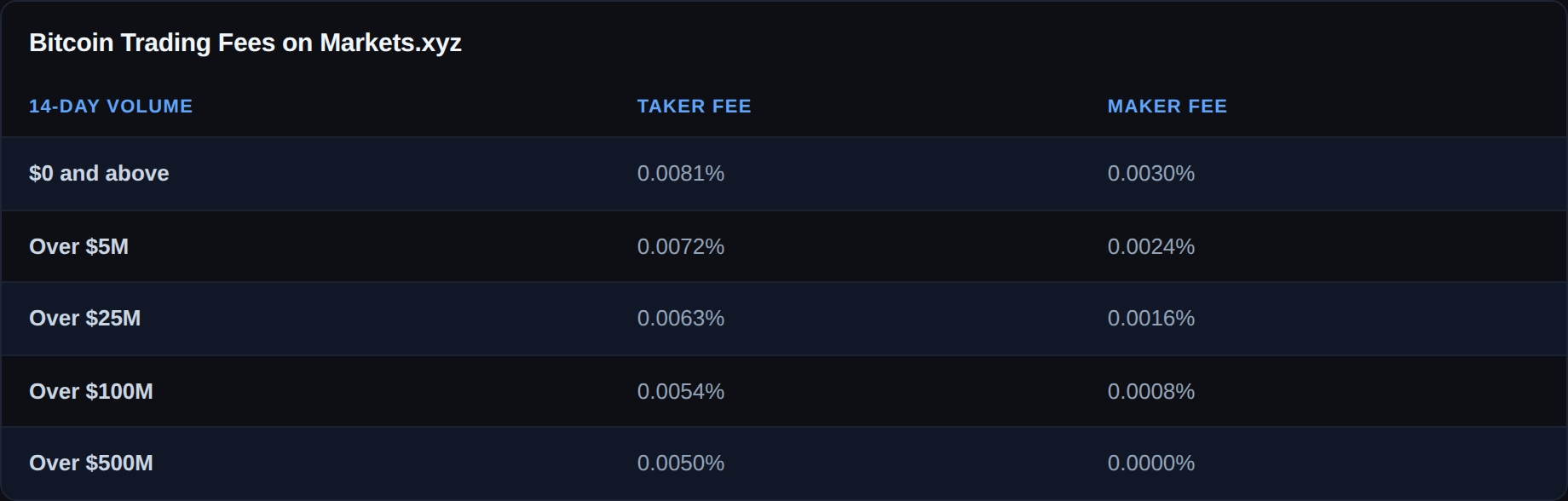
Markets.xyz operates on Hyperliquid infrastructure, inheriting its transparent and competitive fee structure. A 90% growth mode fee reduction is currently active on all HIP-3 markets. The base perpetual fees after this discount are:
Builder fees
A small builder fee is applied on top of base Hyperliquid fees when trading through the Markets.xyz front end. At the base tier, the combined total fee for a taker trade is 0.0431% and for a maker trade is 0.038%. Both can be reduced through volume tiers and staking discounts.
Fee discounts
Two additional ways to reduce your trading costs on Markets.xyz:
• HYPE staking: Stake HYPE tokens to unlock up to 40% discount on base Hyperliquid fees, starting with 5% for staking over 10 HYPE
• Aligned Quote Asset (AQA): Using USDH as your quote asset gives you a 20% taker fee discount and 50% increased maker rebates
Gas and funding costs
There are no gas fees on trades as these are covered by Hyperliquid. Deposits incur bridge gas on the source chain, and withdrawals carry a minimal Hyperliquid network fee. Funding rates on BTC perpetuals are assessed every hour and are displayed on the platform in real time before you open any position.
Risk management for Bitcoin traders
Bitcoin is one of the most volatile tradeable assets in the world. That volatility is the source of its opportunity, and the source of its danger. The traders who last long enough to become consistently profitable are almost always the ones who take risk management more seriously than strategy selection.
The 1% rule
Never risk more than 1 to 2% of your total trading capital on any single BTC trade. This means if you have $10,000 in your trading account, your maximum loss on one trade should be $100 to $200. This rule keeps a string of bad trades from wiping out your account and gives you the staying power to recover and improve.
Always use a stop-loss
In a market that trades 24/7 and can move 10% in an hour, an unprotected leveraged position is an accident waiting to happen. Every BTC trade on Markets.xyz should have a stop-loss set at the time of entry, not after the trade moves against you. Markets.xyz supports stop orders natively, meaning your exit is automated and will execute even while you sleep.
Understand your liquidation price before you enter
Markets.xyz displays your liquidation price clearly when you configure a trade. Before you click confirm on any leveraged BTC position, know exactly what price would liquidate you and whether that level is realistic given current market volatility. If the liquidation price is too close to current market conditions, reduce your leverage or position size.
Don't average down on losing leveraged positions
Adding to a leveraged position that is moving against you (sometimes called averaging down) is one of the most common ways traders blow up accounts. In spot trading with low or no leverage, averaging down can be a legitimate accumulation strategy. In leveraged perpetuals trading, it accelerates your path to liquidation. If the market is proving your thesis wrong, respect it and exit.
Separate your trading capital from your long-term holdings
If you hold Bitcoin as a long-term investment, keep that capital completely separate from your trading capital. Trading leverage with your long-term BTC savings is a recipe for regret. Treat your trading account as a standalone operation with its own budget that you can afford to lose without affecting your broader financial position.
Use the TWAP order type for large positions
Markets.xyz offers TWAP (time-weighted average price) orders, a professional execution tool that breaks a large order into smaller pieces executed over time. This minimizes market impact when entering or exiting large BTC positions and gives you a better average fill price than dumping the full size into the market at once.
How to trade Bitcoin on Markets.xyz: step-by-step
Here's how to go from zero to your first BTC trade on Markets.xyz.
Step 1: Set up a web3 wallet
Markets.xyz is non-custodial, meaning you connect your own wallet rather than creating an account with a username and password. Compatible wallets include MetaMask, Rabby, and any Web3 wallet. Download your wallet, store your seed phrase securely offline, and you're ready to proceed.
Step 2: Fund your wallet with USDH
All positions on Markets.xyz are margined in USDH, a stablecoin. Fund your wallet with USDH directly using crypto. The platform supports deposits from major chains, with bridge gas on the source chain being the only deposit cost. No bank transfers, no KYC forms, no waiting periods.
Step 3: Connect to Markets.xyz
Navigate to markets.xyz and click Connect. Select your wallet and approve the connection. Your wallet address becomes your identity on the platform. The entire process takes under a minute.
Step 4: Navigate to the BTC market
From the trade screen, select BTC from the asset list. You'll see the live price, the orderbook, current funding rate, and the trade panel. Take a few minutes to review all of this before placing any order. The L4 orderbook shows individual orders, not just aggregated levels, giving you real-time insight into where liquidity sits.
Step 5: Configure your trade
Select Long or Short depending on your directional thesis. Choose your order type (Market for immediate execution at current price, or Limit to specify your entry price). Set your position size in USDH and your leverage level. The platform will show you your margin requirement, estimated liquidation price, and fee before you confirm. Set your stop-loss and take-profit levels.
Step 6: Monitor and manage
Once your BTC position is open, monitor it via the portfolio panel. You'll see real-time unrealized PnL, margin usage, funding payments, and your liquidation price. Adjust stop-losses as the trade progresses if your thesis plays out and you want to lock in profits. Close the position manually or let your take-profit order execute automatically.
Connect your wallet, fund with USDH, and start trading BTC on a fully decentralized platform. No KYC, no closing time, no middleman. Start trading on markets.xyz.
Frequently asked questions
Can I trade Bitcoin 24/7 on Markets.xyz?
Yes. Bitcoin perpetual futures and spot trading on Markets.xyz are available 24 hours a day, 7 days a week, 365 days a year. There is no closing time, no weekend downtime, and no holiday schedule. The platform operates continuously on Hyperliquid's blockchain infrastructure.
What is the maximum leverage for Bitcoin on Markets.xyz?
Markets.xyz offers up to 50x leverage on select BTC markets. This means a $1,000 margin deposit can control a $50,000 BTC position. Leverage above 10x is recommended only for experienced traders with robust risk management in place. Always understand your liquidation price before using high leverage.
What currency is used for margin on BTC trades?
All positions on Markets.xyz are margined in USDH, a stablecoin. This means your margin value doesn't fluctuate with the crypto market while your trade is open, giving you a stable and predictable collateral base for all your positions.
What is a funding rate and how does it affect my BTC position?
A funding rate is a periodic payment exchanged between long and short holders of a perpetual futures contract. It keeps the perpetual price anchored to the underlying Bitcoin spot price. On Markets.xyz, funding is assessed every hour. When the perpetual trades at a premium to spot, longs pay shorts. When it trades at a discount, shorts pay longs. Funding rates are displayed on the platform before you open any position.
Is Markets.xyz non-custodial for Bitcoin trading?
Yes. Markets.xyz is fully non-custodial. You connect your own Web3 wallet and your funds are never held by Markets.xyz or any third party. All trades are executed through smart contracts on Hyperliquid's blockchain, and you can withdraw your funds at any time without requiring approval.
Can I trade Bitcoin from any country?
Markets.xyz is accessible to traders in 180+ countries. Users based in the USA, UK, and Ontario, Canada are not eligible due to regulatory considerations. All other regions have full access to BTC trading on the platform.
What is the difference between BTC spot trading and BTC perpetual futures?
Spot trading means you purchase actual Bitcoin at the current market price and own the asset. Perpetual futures allow you to trade Bitcoin's price movement without owning it, with the ability to use leverage and go short. Both are available on Markets.xyz. Spot is better suited for long-term accumulation. Perpetuals are the preferred instrument for active traders who want leverage, short-selling capability, and maximum capital efficiency.
What order types are available for BTC trading on Markets.xyz?
Markets.xyz supports Market orders (immediate execution at current price), Limit orders (execute at a specified price), Stop orders (for stop-loss and stop-limit execution), TWAP orders (time-weighted average price for large position execution), and Scale orders (automated dollar-cost averaging across a price range). This is a professional-grade order suite available to all traders on the platform.
Conclusion
Bitcoin in 2026 is a mature, globally traded asset with deep liquidity, a well-established halving cycle, and growing institutional adoption. But it remains one of the most volatile and opportunity-rich assets available to traders anywhere in the world.
Trading BTC effectively requires more than just a directional view. It requires understanding the difference between spot and perpetuals, knowing how leverage and funding rates affect your position economics, having a clear risk management framework, and being on a platform that gives you access to the full toolkit whenever you need it.
Markets.xyz is built for exactly this. A decentralized, non-custodial platform where you can trade Bitcoin perpetuals with up to 50x leverage, access spot markets, use professional order types including TWAP and Scale, and do all of it 24/7 without geographic restrictions, custody risk, or platform downtime.
The Bitcoin market never sleeps. Your platform shouldn't either.
Trade Bitcoin on the platform built for 24/7 markets. Start trading on markets.xyz.