How to trade SpaceX before the IPO
SpaceX may become the largest IPO ever. Markets.xyz breaks down the pre-IPO setup, current SPCX pricing, valuation signals, and what traders should watch before Nasdaq opens.
SpaceX is no longer just the private company everyone wants access to.
For years, the only way to get exposure was through venture rounds, tender offers, secondary brokers, accreditation gates, and stale private marks. Most traders had no real shot at the trade until the Nasdaq open.
Now, before SpaceX shares officially list, the market is already forming a view on where SPCX should trade.
So the question is no longer whether SpaceX matters. Everyone knows it does.
The real question is: what price will public markets actually accept when SpaceX finally opens?
The SpaceX IPO setup
According to Reuters, SpaceX is targeting a Nasdaq listing as early as June 12, 2026, under the reported ticker SPCX.
The company is reportedly seeking to raise around $75.00B at a valuation near $1.75T, which would make it the largest IPO ever if completed on those terms.
That headline is massive, but the final terms are still not locked.
The official IPO price range, share count, and primary / secondary mix still depend on the final public filing and underwriting process.
SpaceX has also reportedly approved a 5-for-1 stock split, adjusting its fair market value from $526.59 per share to $105.32 per share.
That number matters, but it is not the IPO price.
Barron’s has reported that the expected IPO price could be closer to $160.00 per share, while also noting that SpaceX could be valued at up to $2.00T depending on final pricing and demand.
So the clean version is this:
Reported IPO target valuation: around $1.75T
Reported expected IPO price: around $160.00 per share
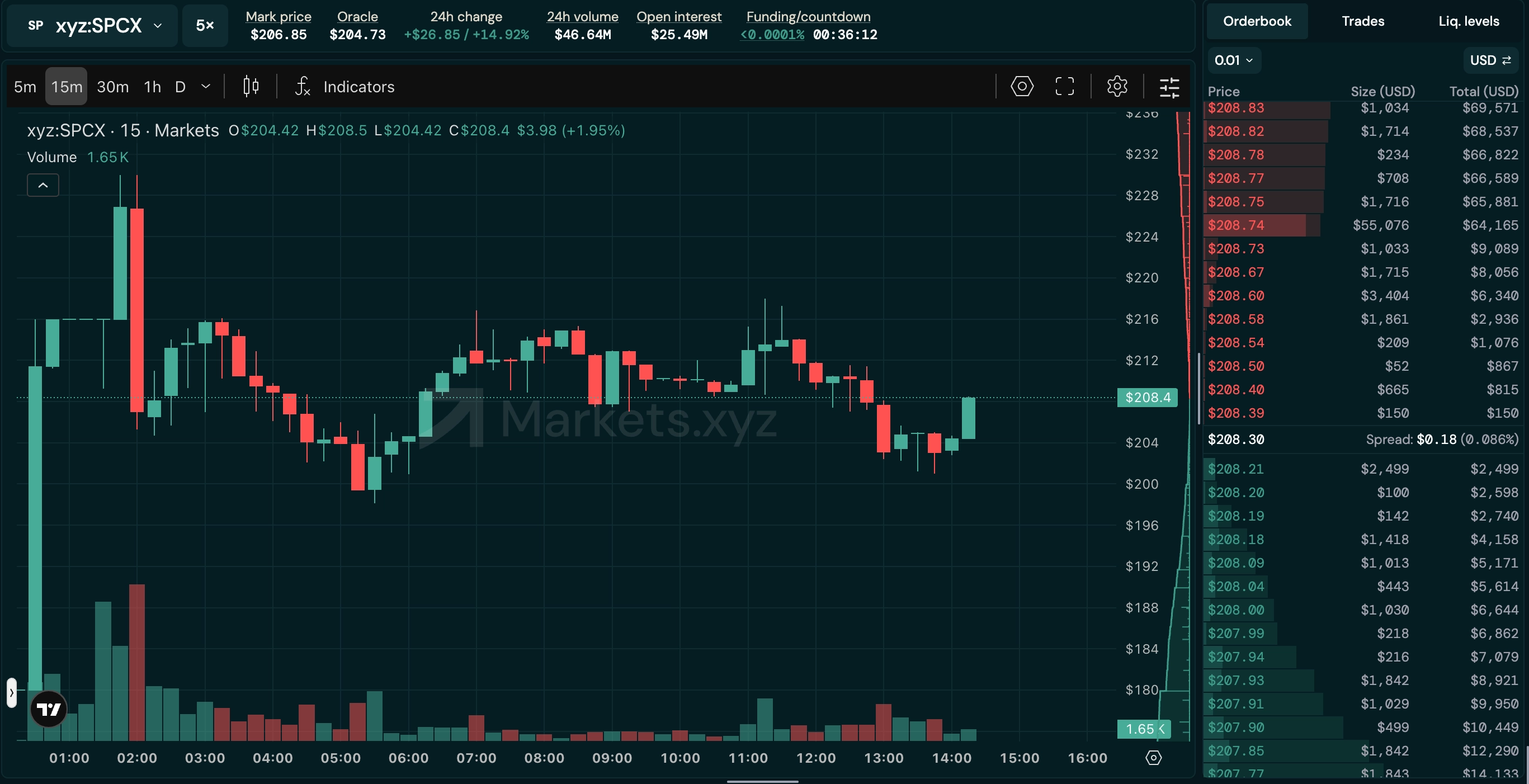
Current onchain SPCX pricing: $210-220 per share
Final terms: still pending
That gap is the trade.
The SpaceX valuation ladder
SpaceX funding data varies by provider because some sources count only primary rounds, while others include secondary transactions, tender offers, and valuation marks.
The broad picture is clear: SpaceX has moved from a late-stage private unicorn to a potential trillion-dollar public company in less than three years.
Sacra estimates that SpaceX has raised roughly $12.00B in primary funding.
The last major primary round most trackers point to was in January 2023, when SpaceX reportedly raised $750.00M at a $137.00B valuation.
After that, the story became less about primary venture rounds and more about secondary liquidity, tender offers, and private-market repricing.
Key valuation milestones:
January 2023
Primary round
Reported valuation: $137.00B
December 2023
Tender offer
Reported valuation: $180.00B
December 2024
Secondary / tender valuation
Reported valuation: ~$350.00B
July 2025
Secondary valuation
Reported valuation: ~$400.00B
December 2025
Tender offer
Reported valuation: ~$800.00B
June 2026 target
Reported IPO
Reported valuation: ~$1.75T
That is the entire repricing in one line:
SpaceX went from a $137.00B primary round in 2023 to a reported $1.75T IPO target in 2026.
Private-market scarcity became public-market ambition.
What SPCX-USDC is really pricing
SPCX-USDC is not SpaceX stock.
It is not an IPO allocation, and it is not tokenized equity.
It does not give ownership, voting rights, dividends, or shareholder claims.
It is a pre-IPO perp designed to track expected SpaceX share-price discovery before the public listing.
In a normal IPO, investors get access after the company has priced its shares through banks, roadshows, allocation decisions, and exchange mechanics.
SPCX-USDC gives the market a way to express the trade before that process finishes.
In plain English:
SPCX-USDC is the market saying where it thinks SpaceX shares should trade before Nasdaq gives the official answer.
That is why the current price matters less than the structure.
The mark will move.
The volume will move.
The open interest will move.
But the important part is that the market is already forming a view before the IPO opens.
Why the current SPCX price matters
At the latest snapshot, SPCX-USDC was trading around $210.00, well above the reported expected IPO price of around $160.00.
That number will move. The important signal is the premium.
Right now, the onchain market is pricing SpaceX above the reported IPO expectation before Nasdaq has given the official answer. If the IPO prices closer to $160.00, current SPCX levels imply traders are already paying up for expected opening-day demand.
If the IPO prices higher, or if the first public trades come in materially above the offer price, SPCX may have been early to the repricing.
That is the setup: the market has already created a pre-IPO premium, and the Nasdaq open will decide whether that premium was justified or too aggressive.
Why this matters for traders
This is exactly the kind of market structure that did not exist for most traders before.
Historically, the best IPO access went to institutions, insiders, and clients with allocation.
Everyone else waited for the opening print.
By the time retail could trade, the cleanest part of the price discovery was often already gone.
SPCX changes the timing. It lets traders express a view before the traditional market opens.
That is the important part.
The IPO is still the official event.
SPCX is the live market expectation before the event.
The bull case
The bull case is easy to understand.
SpaceX controls one of the most important private infrastructure businesses in the world.
It has launch dominance, Starship optionality, government demand, Starlink, and one of the strongest brand narratives in public markets.
Starlink is the cleanest valuation bridge because it turns SpaceX from a launch company into a recurring-revenue communications platform.
Sacra estimates that SpaceX generated $18.70B in revenue in 2025, with Starlink contributing $11.40B.
Sacra also estimates that Starlink passed 10.00M active customers by February 2026.
That changes the public-market frame.
SpaceX is not just rockets.
It is launch infrastructure, satellite internet, defense connectivity, direct-to-device optionality, AI infrastructure ambition, and Musk-controlled industrial risk in one listing.
Reuters reported that BlackRock has discussed investing $5.00B-$10.00B in the IPO, while also noting that Reuters could not independently verify the original report from The Information.
What traders should watch next
The official IPO price range
This will tell the market whether the current onchain premium is realistic or stretched.
The final share count
Without the final share count, every implied market-cap calculation is only a rough sensitivity.
The final valuation
A $1.75T IPO and a $2.00T IPO are very different trades.
Opening-day demand
If the IPO is heavily oversubscribed, the public open could validate the premium.
SPCX liquidity
Volume and open interest matter more than the exact mark because they show whether the market is deep enough to absorb real positioning.
Conversion mechanics
Traders need to understand what happens when the pre-IPO market becomes linked to post-IPO public data.
Why Markets is watching
The SpaceX setup is bigger than one IPO, it is a preview of where markets are going.
Private-company narratives, IPO expectations, public equity demand, and onchain price discovery are starting to collide in real time.
That is exactly the type of market structure Markets.xyz is built to track.
Bottom line
SpaceX pre-IPO is no longer just a private-market story, it is now a live market-structure story.
Reuters says SpaceX is targeting a $75.00B raise at roughly $1.75T.
SPCX-USDC is already pricing expected SpaceX share value before the IPO.
The filing will give the market the official numbers.
The opening print will give the market the public answer.
But the trade has already started.
SpaceX is not waiting for Nasdaq to become a market.
The market is already here.
FAQ
Where can I trade this?
You can trade SPCX-USDC directly on https://markets.xyz/trade/xyz:SPCX from desktop.
If you are on mobile, download the Markets app here: https://markets.xyz/mobile-app/
When is the SpaceX IPO expected?
Reuters has reported that SpaceX is targeting a Nasdaq listing as early as June 12, 2026, but the final timeline depends on the public filing and underwriting process.
What is the expected SpaceX IPO valuation?
The reported IPO target is around $1.75T, with some reports discussing a possible valuation of up to $2.00T depending on final pricing and demand.
What is SPCX-USDC?
SPCX-USDC is a pre-IPO perp market that tracks expected SpaceX share-price discovery before the public listing.
It is not SpaceX equity, an IPO allocation, or tokenized stock.
Does SPCX-USDC give ownership of SpaceX?
No.
SPCX-USDC does not give ownership, voting rights, dividends, or shareholder claims.
It is a derivative market for price exposure.
Why is SPCX trading above the reported IPO price?
Because the market is pricing expectations before the IPO. If traders believe public demand will push SpaceX above the reported range, SPCX can trade at a premium.
That premium can be right.
It can also be wrong.
What should traders watch before the IPO?
The official price range, final share count, final valuation, opening-day demand, SPCX liquidity, and the conversion mechanics after listing.
Sources
Reuters: SpaceX accelerates IPO timeline, targets June 12 listing on Nasdaq
Reuters: SpaceX shareholders approve 5-for-1 stock split
Barron’s: SpaceX stock split and expected IPO price
Reuters: BlackRock weighs multibillion-dollar investment in SpaceX IPO