
Multicoin says it did not unstake 1.97M HYPE to sell
Tushar Jain says Multicoin did not unstake 1.97M HYPE to sell. The wallet trail supports the claim, although future sale risk remains.
Multicoin unstaked nearly 2M HYPE. It says it did not do it to sell.
That is no longer just our interpretation of the wallets. On July 22, Tushar Jain, Multicoin’s co-founder and managing partner, confirmed that the firm made the unstake and said its funds regularly rotate wallets because their positions are constantly tracked.
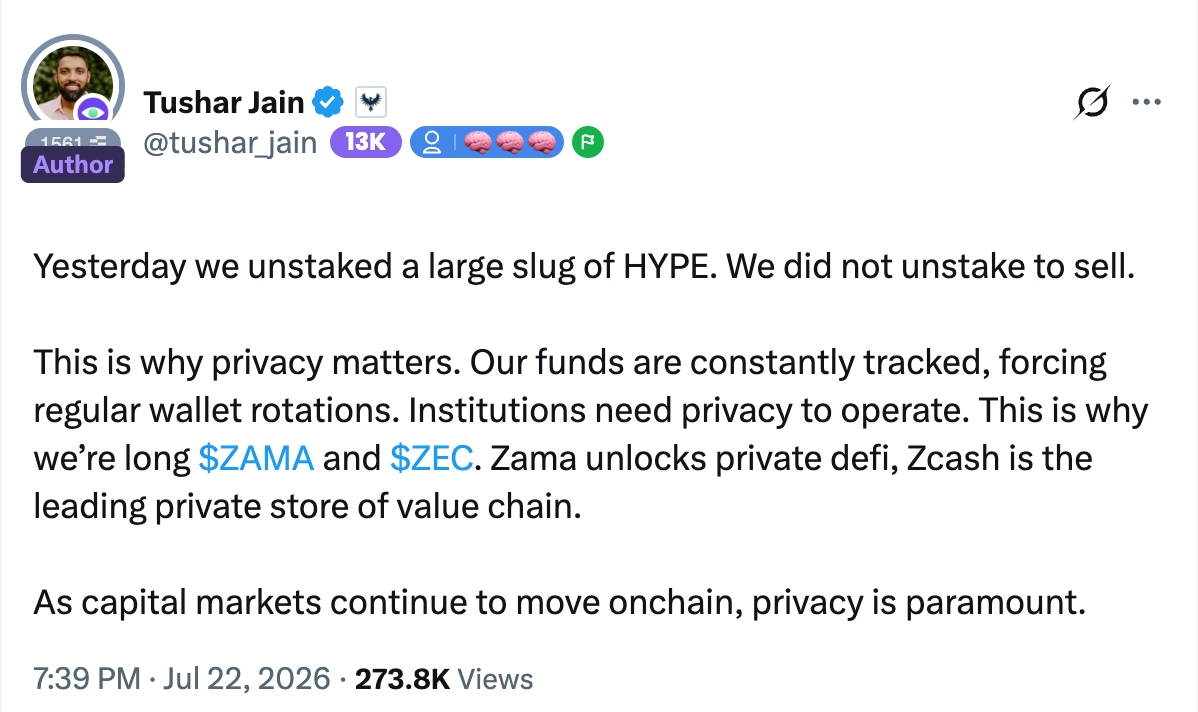
Tweet URL: Tushar Jain’s statement on Multicoin’s HYPE unstake
“Yesterday we unstaked a large slug of HYPE. We did not unstake to sell,” Jain wrote.
A statement from the holder is not proof. Multicoin has an obvious incentive to calm fears of a sale worth more than $100M, reduce front-running, and preserve a better execution price if it later decides to sell.
But the chain was already pointing in the same direction.
The verified 395,570.648 HYPE tranche was split, returned, consolidated, and relayed through several addresses in near-full amounts. It did not move directly into visible exchange liquidity.
The best-supported conclusion is now clear: the unstake was part of an operational wallet rotation, not the start of an immediate onchain sale. The remaining risk is what Multicoin does after the rotation.
Key takeaways
- Tushar Jain confirmed that Multicoin made the large HYPE unstake and said it was not initiated to sell.
- Markets tracked three unstaking positions totaling approximately 1.97M HYPE, worth about $116M at the July 23 factual cutoff.
- The verified 395,570.648 HYPE tranche was repeatedly split, returned, consolidated, and forwarded through additional wallets.
- The transaction pattern supports Multicoin’s wallet-rotation explanation, but it cannot exclude a future sale or an offchain transaction through Coinbase Prime.
- The next destination of the unstaked HYPE will matter more than the unstaking request itself.
What Multicoin confirmed
Jain’s statement resolves the main attribution question behind the original analysis.
Multicoin was responsible for the large unstake.
Markets had identified three connected unstaking positions totaling approximately 1,969,603 HYPE. At a reference price of $58.88, the tokens were worth approximately $116.0M.
Jain did not publish the exact token amount or identify the individual wallet addresses. However, the timing and wording of his post clearly connect it to the large Multicoin-linked unstake being tracked by the market.
His statement confirms two points:
- Multicoin initiated the unstake.
- The firm says the purpose was not to sell.
It does not confirm that Multicoin will never sell the tokens. It also does not prove that every address in the broader four-cluster wallet map belongs to the firm.
The distinction matters.
An unstake is not a sale. Under Hyperliquid’s staking rules, HYPE enters a seven-day queue before it can move from a staking account back to a spot account.
The transaction creates liquid supply and gives the holder more options. It does not show which option the holder will choose.
The chain already looked like wallet rotation
The clearest verified flow began at:
0x1083a685A10eeA52147D94B2Fb4d94283f0adCD3
On July 21 at 19:54:58 UTC, the wallet sent exactly 395,570.648 HYPE to:
0x7e43ed8765e708E5c40Eb7d2f6eE9BdAE0Ff0E8B
The transfer was worth approximately $23.3M at the July 23 reference price.
Markets identified the receiving address as part of a Coinbase Prime-associated routing path based on its transaction history and connections. HyperEVMScan does not apply an official Coinbase label to the address, so the attribution remains analytical rather than confirmed by Coinbase.
About one hour after receiving the HYPE, the routing address sent:
- 291,511.318 HYPE to
0x4bF023A3b04C3425e999cF4E378e217C356002A4 - 30,229.138 HYPE to the same address,
0x4bF023A3b04C3425e999cF4E378e217C356002A4 - 73,736.883 HYPE to
0x61196eA84fD78459e6F7B4483326efC363cCD797
The initial split did not mark the end of the route.
On July 22, 0x4bF023A3b04C3425e999cF4E378e217C356002A4 returned 323,901.465 HYPE to the original routing address, 0x7e43ed8765e708E5c40Eb7d2f6eE9BdAE0Ff0E8B.
One minute later, the router sent 338,328 HYPE to: 0xFE85aD0B06b1d6e51CdCFEA07e0c22a73E7D9221
That intermediary held the position for just 46 seconds before forwarding 338,327.999 HYPE to: 0x0aEe1665aFd0c14615b538333fd6F97e4a8cBF98
The intermediary retained effectively none of the position.
The second downstream wallet, 0x61196eA84fD78459e6F7B4483326efC363cCD797, also returned several HYPE tranches to the original router, 0x7e43ed8765e708E5c40Eb7d2f6eE9BdAE0Ff0E8B. The tokens were then routed onward through other addresses.
This is the strongest evidence supporting Jain’s explanation.
Temporary wallets received large balances and forwarded almost identical amounts within minutes or seconds. The funds were being relayed and consolidated, not gradually distributed through visible market-liquidity addresses.
The transaction sequence was also already onchain before Jain published his statement. The wallet behavior was not created after the denial to make the explanation appear credible.
It is not proof that beneficial ownership remained unchanged. The final address could belong to a custodian, an institutional service provider, an OTC counterparty, or another party.
But the visible transaction structure looks operational rather than distributive.
Could Multicoin be lying?
Yes, in principle.
Multicoin has an economic interest in how the market interprets the unstake. A large holder publicly announcing that it intends to sell could invite front-running, weaken liquidity, increase slippage, and reduce the eventual execution price.
A strategically misleading denial could have the opposite effect.
If traders believe the supply overhang has disappeared, they may close shorts, stop selling ahead of the unstake, or allow HYPE to recover before Multicoin executes.
Multicoin could also rotate the wallets first, move the tokens into Coinbase Prime, and sell later through an internal order book, an OTC desk, or an execution algorithm.
None of those possibilities can be ruled out from public data.
However, the evidence currently makes that interpretation less likely than Jain’s explanation.
First, the wallet-rotation pattern was visible before his statement.
Second, the verified HYPE moved through near-full relays. One address received 338,328 HYPE and forwarded 338,327.999 HYPE 46 seconds later. That looks like routing infrastructure, not gradual distribution.
Third, Markets’ original wallet map showed more than 600K liquid HYPE still held onchain before the large unstaking requests. If the immediate objective had simply been to start selling, Multicoin already controlled a substantial liquid balance.
Fourth, no direct transfer from the verified tranche into an identifiable exchange-liquidity address has been observed.
An offchain sale remains possible, but the public wallet movements themselves do not show one.
The skeptical theory therefore requires several additional assumptions: Jain’s statement must be strategically misleading, the near-full relays must form part of a concealed exit, and Multicoin must have left its existing liquid HYPE unused while waiting for the seven-day unstaking queue.
That is possible. It is not the best-supported reading of the current evidence.
Why Coinbase Prime does not settle the question
A Coinbase Prime-associated transfer is not proof of a sale.
It is also not proof that the tokens remained under Multicoin’s ownership.
Coinbase Prime combines execution, financing, custody, futures, staking, settlement, and institutional onchain wallet services within one platform.
A client can use the same infrastructure to:
- Hold assets in custody
- Reorganize wallets
- Stake tokens
- Post collateral
- Settle an OTC transaction
- Transfer assets to a counterparty
- Execute a spot or derivatives trade
The public chain can show where the tokens moved. It cannot show the client’s internal instructions, beneficial ownership inside Coinbase’s ledger, or whether an offchain transaction occurred.
That is why “sent to Coinbase Prime” and “sold” are not interchangeable statements.
The routing pattern supports Multicoin’s explanation. Coinbase Prime’s execution capabilities prevent the chain from proving it conclusively.
The existing liquid HYPE matters
Before the large unstaking requests, Markets’ four-cluster wallet map showed more than 600K liquid HYPE still held onchain.
That balance does not prove Multicoin had no intention to sell. A fund preparing a large transaction may prefer to consolidate its entire position before execution.
It could be preparing an OTC block, reorganizing custody, coordinating several accounts, or moving assets into a single execution setup.
But the sequencing still matters.
Multicoin did not need to wait seven days to sell the liquid HYPE it already controlled. Instead, the visible activity centered on wallet routing, consolidation, and custody-related infrastructure.
Combined with Jain’s statement, that makes operational wallet rotation the stronger explanation.
The statement also strengthens the broader attribution of the connected wallet clusters to Multicoin. It does not independently confirm every address or every historical transaction within those clusters.
The common funding patterns, shared counterparties, similar acquisition periods, and synchronized movements remain onchain evidence, not legal proof of beneficial ownership.
The real story is institutional privacy
Jain used the HYPE episode to make a broader point about privacy.
He said Multicoin’s funds are constantly tracked, forcing regular wallet rotations. He then connected that problem to the firm’s positions in ZAMA and ZEC.
That is Multicoin’s investment thesis, not independent evidence that either asset will capture institutional privacy demand.
The underlying market-structure problem is real.
Public blockchains expose operational movements that would remain private inside a traditional prime brokerage account. A staking change, custody transfer, wallet rotation, or collateral movement can be interpreted as a directional trade before the institution has entered the market.
Hyperliquid’s seven-day unstaking queue makes that tension more visible.
A holder must reveal that its HYPE is becoming liquid before the tokens can be moved. Traders can then price a potential sale before knowing whether a sale is actually planned.
The market sees preparation. It guesses intent.
That creates a transparency tax for institutions operating onchain.
A fund rotating wallets for security reasons can be treated as a seller. A custodian transfer can be interpreted as distribution. The resulting positioning can move the market before the underlying tokens reach exchange liquidity.
Privacy would reduce that front-running and protect operational security. It would also make concentration, solvency, conflicts of interest, and market manipulation harder to monitor.
The institutional solution is unlikely to be complete opacity. It is more likely to involve selective privacy combined with auditable controls.
What would invalidate the wallet-rotation thesis?
The current evidence supports Jain’s explanation, but the conclusion can change.
The sale thesis would become stronger if:
- The unstaked HYPE moves into identifiable exchange hot wallets.
- Prime-associated addresses settle large balances with known OTC or market-making counterparties.
- The transfers coincide with sustained spot-led selling and higher exchange inventories.
- The HYPE is divided into repeated transfers consistent with active execution.
- New evidence shows that the routing sequence formed part of a completed offchain sale.
The wallet-rotation thesis would become stronger if:
- The unstaked HYPE follows the same near-full relay pattern.
- The tokens move into new operational wallets without entering visible market liquidity.
- The HYPE is restaked from new addresses.
- Multicoin or a custodian provides additional confirmation of the custody structure.
A later sale would not automatically prove that Jain’s statement was false.
His claim was that Multicoin did not initiate this unstake for the purpose of selling. The fund could rotate the wallets now and make a separate decision to sell later.
The relevant question is whether the unstake formed part of an immediate exit plan. The available evidence says it probably did not.
What traders should watch next
- The completion of the unstaking queue. Based on the original transaction timestamps, the approximately 1.97M HYPE should become liquid around July 28.
- The first destination. A new staking address, a Prime-associated router, an OTC settlement address, and an exchange hot wallet would carry different implications.
- Restaking activity. Delegation from newly funded wallets would provide the clearest public support for the rotation explanation.
- Near-full wallet relays. More transfers that leave temporary addresses almost empty would reinforce the operational-routing interpretation.
- Spot activity. Identifiable exchange inflows accompanied by sustained spot selling would provide stronger sale evidence than price action alone.
- Further Multicoin disclosures. A portfolio update, custodian statement, or direct wallet confirmation could resolve the remaining attribution questions.
The bottom line
Tushar Jain’s statement changes the base case, but traders do not need to take it on faith.
Multicoin has confirmed that it initiated the large HYPE unstake and says it did not do so to sell. The verified wallet activity supports that explanation.
The HYPE was split, returned, consolidated, and relayed through additional addresses in a pattern that looks operational rather than distributive.
Multicoin could still sell later. It could also execute through Coinbase Prime without producing a clear public onchain trail.
But there is currently no evidence that the unstake marked the start of an immediate HYPE dump.
The chain does not show a sale. It shows a fund trying to stop the chain from showing its hand.
Trade HYPE on Markets
HYPE remains one of the most actively traded assets on Hyperliquid, and events like large unstaking requests can create sharp moves before the underlying intent is clear.
You can trade HYPE directly on Markets with access to the live chart, order book, position controls, and Hyperliquid-native execution.
HYPE is traded through a perpetual contract, not as spot ownership of the token. Perpetuals can involve leverage, liquidation, and total-loss risk.
Sources
- Tushar Jain. “Statement on Multicoin’s HYPE unstake and wallet rotations.” July 22, 2026. X post.
- Multicoin Capital. “About.” Accessed July 23, 2026. Official team page.
- HyperEVMScan. “Coinbase Prime-associated routing address.” Accessed July 23, 2026. Address record.
- HyperEVMScan. “First downstream routing address.” Accessed July 23, 2026. Address record.
- HyperEVMScan. “Second downstream routing address.” Accessed July 23, 2026. Address record.
- HyperEVMScan. “338,328 HYPE relay address.” Accessed July 23, 2026. Address record.
- HyperEVMScan. “Downstream operational address.” Accessed July 23, 2026. Address record.
- Hyperliquid. “Staking.” Accessed July 23, 2026. Official documentation.
- Coinbase. “Coinbase Prime.” Accessed July 23, 2026. Official product page.
Figures, balances, and wallet activity are current as of July 23, 2026.
This article is for informational purposes only and does not constitute investment advice. Derivatives can involve leverage, liquidation, and total-loss risk.