The complete guide to 24/7 trading markets: how to trade any asset, anytime, anywhere
Learn how to trade any asset 24/7 on Markets.xyz
Introduction
Imagine waking up at 2 AM to news that a major central bank just made a surprise interest rate decision. Or picture yourself on a flight to Singapore when a crypto breakout starts forming on the charts. In traditional finance, you'd have no choice but to watch from the sidelines and wait for markets to open.
That's the old way of trading.
The global financial landscape is shifting fast. Crypto markets never close. Decentralized platforms operate around the clock. And a new generation of traders, from Bangkok to Berlin, from Lagos to Lisbon, is demanding access to markets that match the pace of the world they actually live in.
This guide covers everything you need to know about 24/7 trading: what it is, how it works, who it's for, and how to get started on a platform built from the ground up for non-stop global trading.
Whether you're a complete beginner or an experienced trader looking to make the move to a decentralized 24/7 platform, this is the only guide you'll need.
What is 24/7 trading?
24/7 trading refers to the ability to buy and sell financial assets at any time of day or night, on any day of the week, including weekends and public holidays. Unlike traditional stock markets, which operate within fixed hours (the New York Stock Exchange, for example, runs from 9:30 AM to 4:00 PM Eastern Time, Monday through Friday), 24/7 trading platforms have no opening bell and no closing bell.
The concept emerged from cryptocurrency markets, which by their decentralized nature have never had a "closed" state. Because crypto transactions are processed by blockchain networks rather than centralized clearinghouses, there's no institution that needs to go home at 5 PM.
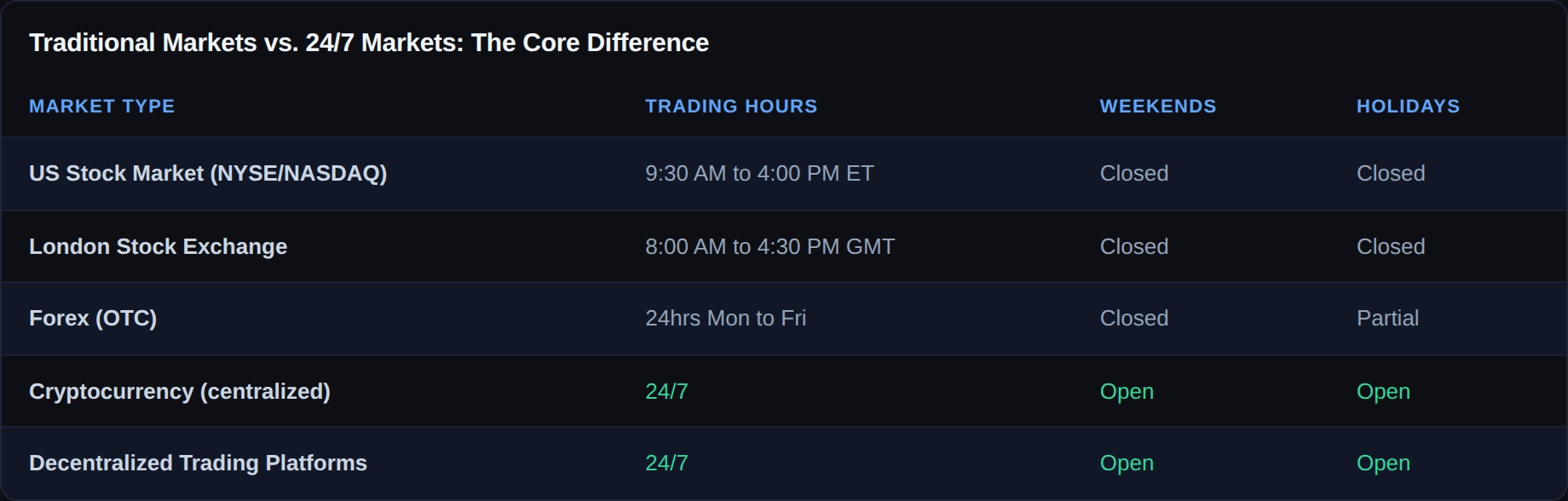
This distinction matters enormously in practice. Major market-moving events, earnings surprises, geopolitical developments, regulatory announcements, macroeconomic data, do not wait for business hours. They happen at 3 AM on a Sunday just as often as they happen at 10 AM on a Tuesday. With a 24/7 platform, you can respond in real time, every time.
Why does 24/7 trading matter?
1. Markets don't sleep, but traditional platforms do
Global news cycles are continuous. A policy shift from the Federal Reserve, a tweet from a major tech founder, a conflict in a commodity-producing region, any of these can trigger significant price movements the moment they happen. If your platform is closed, you can't act. By the time markets reopen, the opportunity may have passed, or worse, the damage may already be done to your portfolio.
24/7 trading removes that gap entirely.
2. The world trades across time zones
The traditional financial system was largely built around Western business hours, specifically New York and London. For the billions of traders in Asia, Africa, South America, and the Middle East, this has always created an inherent disadvantage.
A trader in Tokyo operating peak hours (9 AM to 3 PM JST) is working while US markets are fully closed. A trader in Nairobi dealing with the Kenyan morning rush is locked out of US equities until late afternoon local time. 24/7 decentralized platforms eliminate this structural inequality. The market is equally accessible whether you're in São Paulo or Seoul.
3. Volatility creates opportunity, around the clock
Crypto markets in particular are known for sharp, fast-moving price action. Significant moves often happen outside traditional market hours, triggered by on-chain events, exchange announcements, or macroeconomic catalysts hitting different time zones first. A 24/7 platform means you're positioned to capture (or protect against) these moves the moment they unfold.
4. Autonomy over your own schedule
Not every trader works a standard schedule. Shift workers, entrepreneurs, stay-at-home parents, students, millions of people have irregular schedules that don't align with 9-to-5 market hours. 24/7 trading puts you in control of when you trade, not the other way around.
How 24/7 trading works
Understanding the mechanics behind 24/7 trading helps you use it more effectively.
Centralized vs. decentralized platforms
There are two main types of 24/7 trading platforms:
Centralized exchanges (CEXs) operate 24/7 but are managed by a company that holds your funds in custody. Binance, Coinbase, and Kraken are examples. While they offer continuous trading, your assets sit in the exchange's wallets, and you're subject to their policies, withdrawal limits, and potential platform downtime.
Decentralized exchanges (DEXs) and decentralized trading platforms operate through smart contracts on a blockchain. There's no central entity holding your funds. Trades are executed on-chain, transparently, and without requiring trust in a third party. This is the more advanced and more secure model.
Markets.xyz operates as a decentralized trading platform built on Hyperliquid's HIP-3 protocol, one of the most sophisticated decentralized infrastructure layers available today. This means your trades are executed through smart contracts, your funds are not held in custody by a corporation, and the platform operates continuously without dependence on any central server that could go down.
The role of liquidity in 24/7 markets
One common concern about 24/7 trading is liquidity, specifically, whether there are enough buyers and sellers at 3 AM to execute trades at fair prices. This is a legitimate question and one that has improved dramatically over the past few years.
On well-designed decentralized platforms, liquidity is provided by automated market makers (AMMs) and liquidity pools that operate algorithmically. This means liquidity exists around the clock, regardless of whether human market makers are actively participating. Spreads may widen slightly during lower-volume periods, but execution is always available.
Order types available in 24/7 trading
Modern 24/7 platforms support the full range of order types that professional traders rely on:
• Market orders: Execute immediately at the current best available price
• Limit orders: Execute only when the asset reaches your specified price
• Stop-loss orders: Automatically close a position if price moves against you beyond a set threshold
• Take-profit orders: Automatically close a position when your target profit is reached
• Conditional orders: Trigger based on specific market conditions
Having access to these order types is especially important in a 24/7 environment. Because you can't monitor the markets every hour of every day, setting up stop-losses and take-profit targets lets you define your risk parameters in advance and let the platform execute your strategy while you sleep.
Understanding global markets and time zones
One of the most powerful strategic advantages of 24/7 trading is the ability to participate across global market sessions. Even though the platform never closes, different regions of the world drive trading activity at different times.
The four major trading sessions
Asian session (Tokyo/Singapore/Hong Kong)
Approximate hours: 11:00 PM to 8:00 AM GMT
The Asian session tends to be characterized by moderate volume, with significant activity in assets tied to Asian economies and technology sectors. Crypto markets often see notable moves during this window, particularly for assets with strong Asian communities (Bitcoin, Ethereum, BNB, and various altcoins).
European session (London/Frankfurt/Zurich)
Approximate hours: 7:00 AM to 4:00 PM GMT
The European session is considered the most active for forex and macro-driven assets. London remains the world's largest forex trading center. The overlap between European and Asian sessions (roughly 7 to 9 AM GMT) can produce significant volatility.
North American session (New York)
Approximate hours: 12:00 PM to 9:00 PM GMT
The US session drives the highest overall volume, particularly in the first two hours after traditional markets open. The New York to London overlap (12:00 to 4:00 PM GMT) is often the most volatile and liquid period across all asset classes.
Off-hours / overnight Session
Approximate hours: 9:00 PM to 11:00 PM GMT
This quieter window between New York close and Asia open can still produce meaningful moves, especially in crypto, where weekend and overnight surprises are common.
Trading strategy across sessions
• Trend-following strategies tend to work well during high-volume overlaps (London/NY)
• Range-bound strategies may perform better during the quieter Asian or off-hours session
• News-based trading requires being available when announcements hit, regardless of local time, which is exactly what a 24/7 platform enables
Asset classes available on markets.xyz
Markets.xyz offers perpetual contracts across a wide range of asset classes, including equities, indices, commodities, rates, and FX. Every market trades 24/7, with no opening bell, no closing time, and no expiry dates. The platform is constantly adding new assets, so the list below continues to grow.
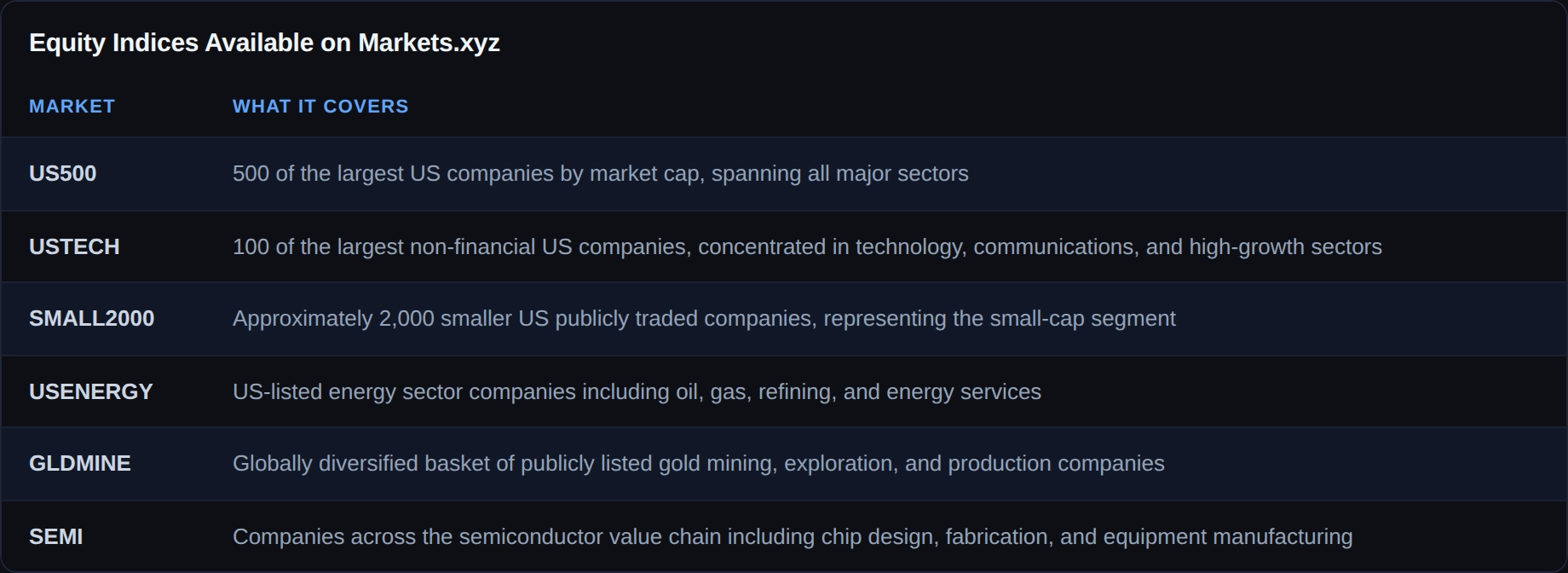
Equity indices and broad market exposure
These markets give you exposure to entire sectors or segments of the equity market through a single perpetual contract, without needing to buy individual stocks.
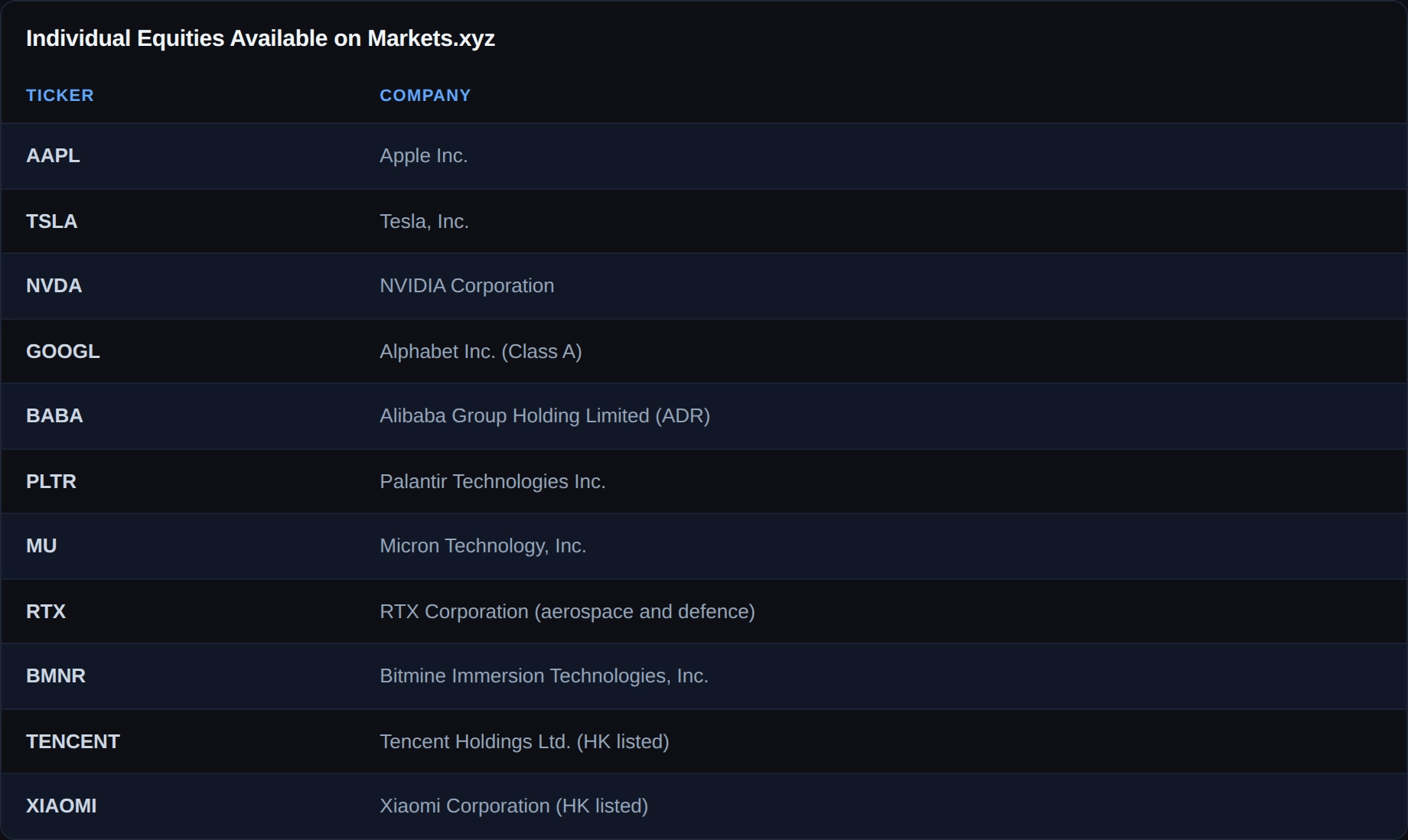
Individual equities
Markets.xyz offers perpetual contracts on some of the world's most actively traded individual stocks, including US-listed and Hong Kong-listed names. This means you can go long or short on individual companies around the clock, with no broker, no settlement delay, and no geographic restrictions on access.
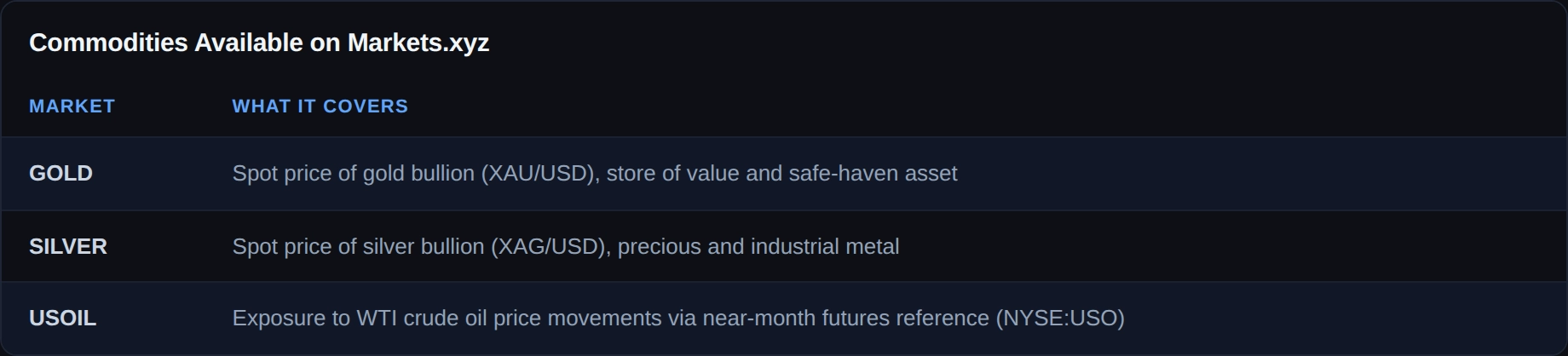
Commodities
Trade gold, silver, and oil as perpetual contracts with no futures rollover complexity. These markets are available 24/7 and are priced using robust, manipulation-resistant oracle references.
Rates and FX
Markets.xyz also covers interest rate and foreign exchange exposure through perpetual contracts, giving traders access to macro-driven markets that traditionally required specialized brokers or institutional access.

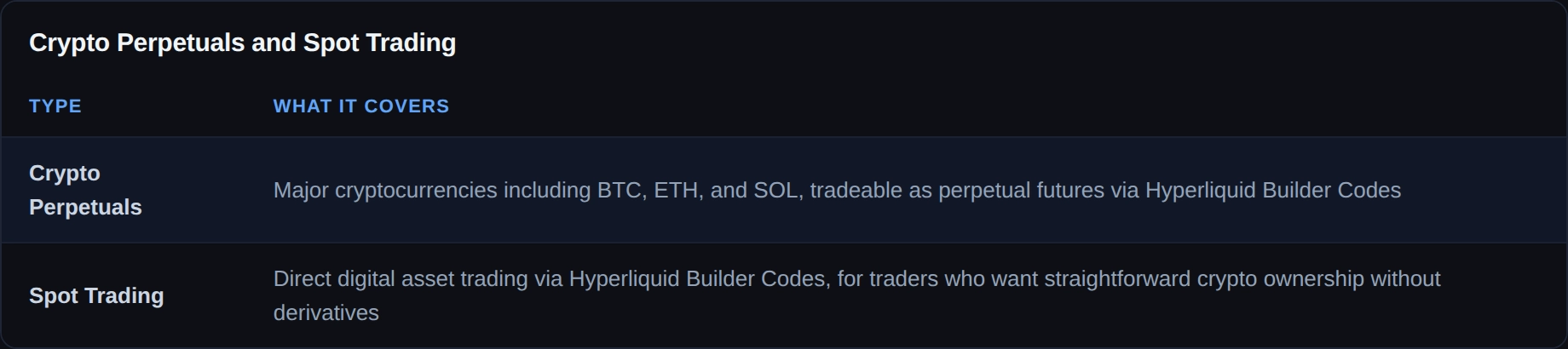
Crypto perpetuals and spot trading
Beyond traditional assets, Markets.xyz integrates with Hyperliquid's builder code infrastructure to offer crypto perpetuals and direct spot trading, making it a unified venue for both traditional and digital asset trading on a single platform.
How perpetual contracts work
Every asset on Markets.xyz trades as a perpetual futures contract. Unlike traditional futures, perpetuals have no expiry date, so you can hold a position for as long as you want provided you maintain sufficient margin. You can go long (profit if price rises) or short (profit if price falls) on any asset, at any time.
Funding rates are periodic payments exchanged between long and short holders that keep the perpetual price anchored to the underlying oracle price. These are a normal part of perpetual trading and are displayed clearly on the platform before you open any position.
Important: Leverage amplifies both gains and losses. A 10% move against a 10x leveraged position results in a 100% loss of the margin deposited. Leverage should only be used by traders who fully understand risk management and position sizing.
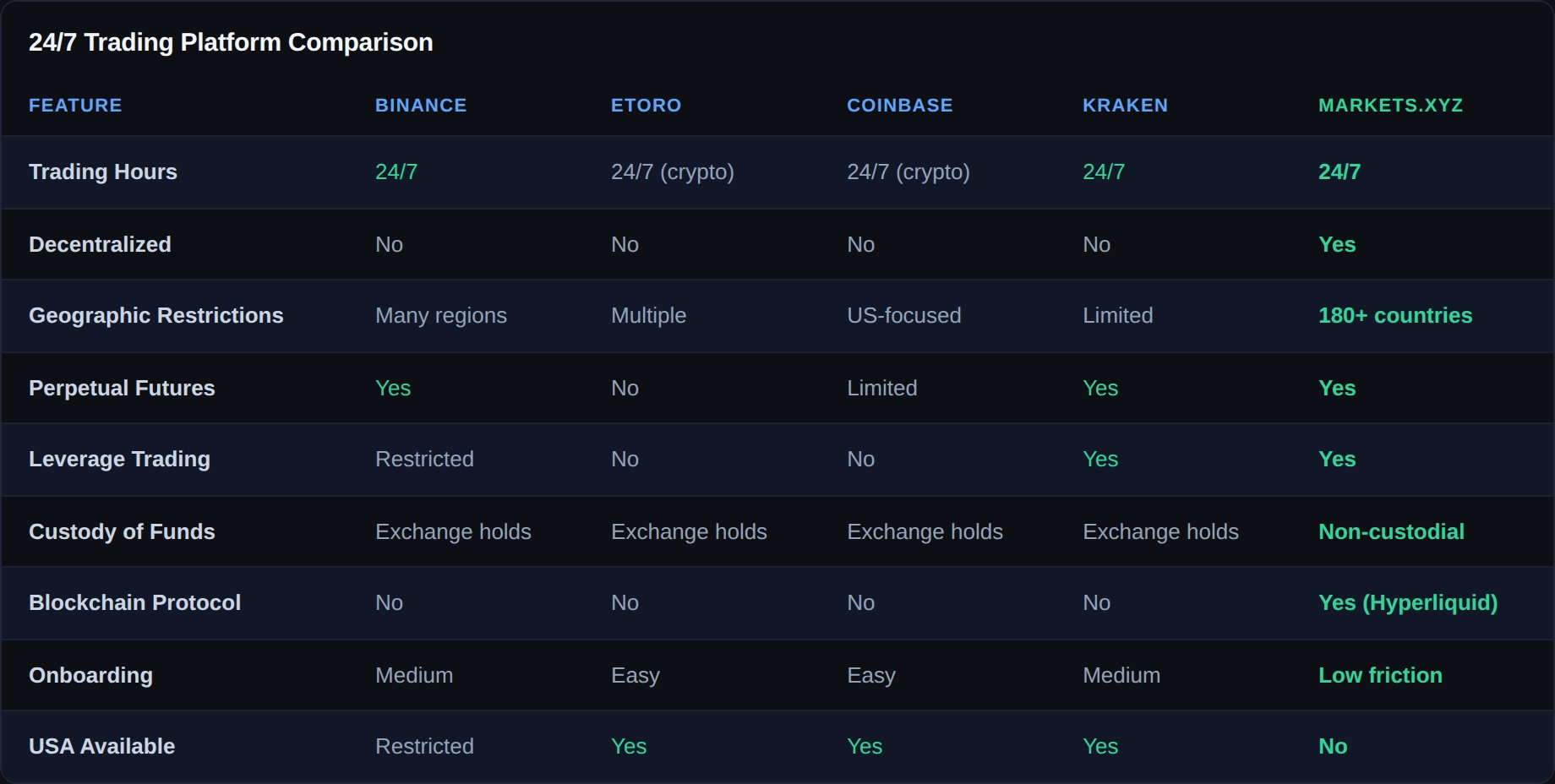
24/7 trading platform comparison
Not all platforms are created equal. Here's how the major players compare on the dimensions that matter most for 24/7 global traders.
Where Markets.xyz stands apart
Decentralized architecture. Most 24/7 platforms are centralized, which means a company holds your funds, can freeze your account, and is subject to regulatory actions that could affect your access overnight. Markets.xyz is built on Hyperliquid's HIP-3 protocol, meaning trades execute through smart contracts. No one holds your funds but you.
Genuine global access. Binance and Coinbase both operate with significant geographic restrictions. Markets.xyz serves traders in 180+ countries, making it one of the most accessible trading platforms on the planet for users outside North America.
Full instrument range. eToro doesn't offer leverage or perpetuals. Coinbase's derivatives offering is limited. Markets.xyz provides spot trading, perpetual futures, leverage, and options on a single, unified decentralized platform.
No artificial downtime. Centralized platforms can, and do, go down for maintenance, during periods of extreme volatility, or due to regulatory actions. A smart-contract-based platform runs as long as the underlying blockchain does, which is essentially continuous.
Trade any market, any time. Start trading on markets.xyz.
Trading strategies for 24/7 markets
The fact that markets never close creates both opportunity and risk. Here are the strategies best suited to a 24/7 trading environment.
1. Momentum trading
Momentum trading involves entering positions in the direction of a strong, established trend and riding it until signs of reversal appear. In a 24/7 market, momentum can build and sustain across multiple time zones as different regional traders pile into the same move.
2. Range trading
During lower-volume periods (particularly the off-hours session), many assets consolidate within a predictable price range. Range traders buy near support levels and sell near resistance levels, capturing the oscillation between the two.
3. News-based trading
Major announcements, regulatory decisions, macroeconomic data, protocol upgrades, exchange listings, can cause sharp, immediate price moves. Being on a 24/7 platform means you can act the moment news breaks, not hours later when traditional markets open.
4. Dollar-cost averaging (DCA)
DCA is not a day-trading strategy, it's a long-term accumulation approach. You invest a fixed amount at regular intervals (daily, weekly, monthly) regardless of price. Over time, this averages your cost basis and reduces the risk of buying at a single bad price point. A 24/7 platform is ideal for DCA because you can set recurring buys at any time that suits your schedule.
5. Automated / algorithmic trading
For traders comfortable with code or with third-party bot services, 24/7 platforms are ideal for automated strategies. A trading bot can execute your rules-based strategy around the clock without you needing to be at a screen. Platforms with open APIs, including Markets.xyz, allow you to connect automated trading systems directly.
Risk management in 24/7 markets
Greater access to markets means greater responsibility for managing risk. Here are the non-negotiable risk management principles every 24/7 trader should follow.
Never trade without a stop-loss
In a market that never closes, an unprotected position can move against you while you sleep. Always set a stop-loss order when entering any leveraged position, and strongly consider them for spot positions as well. A common rule: never risk more than 1 to 2% of your total trading capital on any single trade.
Understand leverage before using it
Leverage is a tool, not a strategy. Using 50x leverage on a volatile asset without understanding how liquidations work is not trading, it's gambling. Start with low leverage (2x to 5x) and only increase it as you develop a consistent track record.
Size your positions correctly
Position sizing is the most underrated skill in trading. Even if your trade thesis is correct, an oversized position can wipe out your account before the trade plays out. A simple rule: calculate your maximum risk in dollar terms before calculating your position size, not the other way around.
Keep a trading journal
In a 24/7 environment, it's easy to overtrade, to make impulsive decisions at 2 AM that you wouldn't make in a more structured session. A trading journal forces discipline. Record every trade: entry, exit, rationale, result. Review it weekly. Patterns will emerge.
Know when not to trade
24/7 access is a privilege, not an obligation. Some of the most successful traders take entire days off. The best trade is sometimes no trade at all, particularly during low-liquidity periods when spreads widen and price action is erratic.
Getting started: step-by-step guide
Here's how to go from zero to your first trade on a 24/7 decentralized platform.
Step 1: Set up a crypto wallet
Since Markets.xyz is non-custodial, you'll need a compatible crypto wallet to connect to the platform. Popular options include MetaMask, Phantom, or any wallet compatible with the Hyperliquid ecosystem. Download your wallet app, securely store your seed phrase (never online, never in photos), and fund it with the crypto you intend to trade.
Step 2: Connect to the platform
Navigate to the Markets.xyz platform and connect your wallet. This is a one-click process, no email, no KYC forms, no waiting period. Your wallet address becomes your identity on the platform.
Step 3: Deposit funds
Transfer the assets you want to trade from your wallet to the platform. Because Markets.xyz is decentralized, this is an on-chain transaction. Your funds move from your personal wallet to a smart contract, not to a corporate account.
Step 4: Explore the interface
Before placing any live trade, spend time with the platform. Review the charting tools, order types, and market data available. Understand how to set stop-losses and take-profit levels. Familiarize yourself with the funding rate display if you plan to trade perpetuals.
Step 5: Start small
Your first trades should be small, sized to learn, not to profit. Use the experience to understand how orders fill, how margin requirements work, and how your chosen assets move during different sessions. Scale up only after you've built confidence and a track record.
Step 6: Set up alerts
Use price alert features to notify you of significant moves even when you're not actively monitoring the platform. This lets you benefit from 24/7 market access without needing to stare at a screen around the clock.
Ready to take your first trade? Sign up in seconds. Start trading on markets.xyz.
Frequently asked questions
Is 24/7 trading safe?
Trading always carries risk, but the 24/7 nature of decentralized platforms does not inherently make it more dangerous than session-based trading. The key safety factors are using a non-custodial platform (so your funds aren't held by a corporation), setting stop-losses on every position, and never trading with money you can't afford to lose.
Do I need to trade at night to benefit from 24/7 access?
No. 24/7 access means you trade on your schedule, not that you need to trade at all hours. The benefit is that markets are available when you want them, including evenings, weekends, and holidays. Most traders still concentrate their activity during the hours most convenient to them.
What's the difference between a centralized and decentralized 24/7 platform?
A centralized platform holds your funds in custody and is operated by a company. A decentralized platform executes trades via smart contracts, and you retain control of your assets at all times. Decentralized platforms are more transparent, typically more censorship-resistant, and not subject to a single company's business or regulatory decisions.
Can I trade crypto 24/7 from any country?
It depends on the platform. Many centralized exchanges have geographic restrictions based on regulatory requirements. Markets.xyz serves traders in 180+ countries, though users based in the USA, UK, and Ontario, Canada are not eligible due to regulatory considerations.
What assets can I trade 24/7 on Markets.xyz?
Markets.xyz offers perpetual futures on equities, indices, currencies, commodities, and cryptocurrencies, all available around the clock. This includes assets like BTC, ETH, US500, gold, oil, and many more.
Is leverage trading suitable for beginners?
Leverage amplifies both gains and losses and carries the risk of liquidation. It is generally not recommended for beginners until they have a solid understanding of risk management, position sizing, and how margin calls work. Start with spot trading and only introduce leverage once you're consistently profitable.
How is a decentralized platform affected by crypto regulations?
Regulatory landscapes vary by country and continue to evolve. Decentralized platforms operate through smart contracts, which makes them structurally different from centralized entities. However, traders are always responsible for understanding and complying with the regulations in their own jurisdiction.
Conclusion
24/7 trading is not a gimmick or a novelty, it's the natural evolution of global financial markets. The world operates around the clock. Capital moves around the clock. Opportunities and risks emerge around the clock. Your trading platform should too.
The rise of decentralized infrastructure has made it possible to participate in global markets with a level of autonomy, transparency, and access that simply didn't exist five years ago. You're no longer dependent on a centralized exchange's business hours, geographic policies, or custody decisions.
Markets.xyz was built for exactly this moment, a decentralized, non-custodial platform with access for traders in 180+ countries, full support for perpetuals across equities, indices, commodities, currencies, and crypto, and infrastructure that runs continuously on the Hyperliquid protocol.
The markets are open. They always are.
Ready to trade any market, any time? Start trading on markets.xyz.