

Why trade 24/7? Market advantages explained
Discover why 24/7 trading is reshaping global markets. Real advantages, who benefits most, and how to capture moves traditional traders miss.
Introduction
It's 3:17 AM in London. A central bank in Asia announces an emergency rate cut. Crypto markets move instantly. The dollar shifts. Equity index futures crack lower. By the time a US trader checks their phone over morning coffee, the move is done. The opportunity, gone.
This kind of moment used to be rare. Now it is routine. Markets reflect the world, and the world does not operate on a 9:30 AM to 4:00 PM Eastern schedule. Central banks act on weekends. Earnings shocks land after the close. Geopolitical news breaks on Sunday morning. And while session-based platforms wait for the next bell, capital is still moving. Just not yours.
24/7 trading is the structural response. Not a feature. Not a marketing line. A fundamentally different way to participate in markets, one that aligns trading access with how the world actually behaves. In this guide we walk through why continuous trading matters, the specific advantages it creates, who benefits most, and how to think clearly about the trade-offs of always-on access.
Whether you're a serious trader looking for structural edge, a global participant outside Western business hours, or someone curious why 24/7 trading is reshaping the industry, this guide is for you.
We'll cover the seven structural advantages that continuous markets create, the five trader profiles where the change is most dramatic, the real scenarios where having access at any hour translates into measurable edge, the opportunity cost of staying with session-based platforms, the difference between platforms that claim 24/7 access and those that genuinely provide it, and the discipline considerations that come with always-on markets. By the end, you'll have a clear picture of why this shift is happening and what it means for how you trade.
24/7 trading means markets remain accessible outside regular exchange hours, including nights, weekends, and holidays. For crypto, this has been the default for years. The next step is applying the same continuous market structure to equities, indices, commodities, and FX through on-chain trading infrastructure.
The shift from session-based to continuous markets
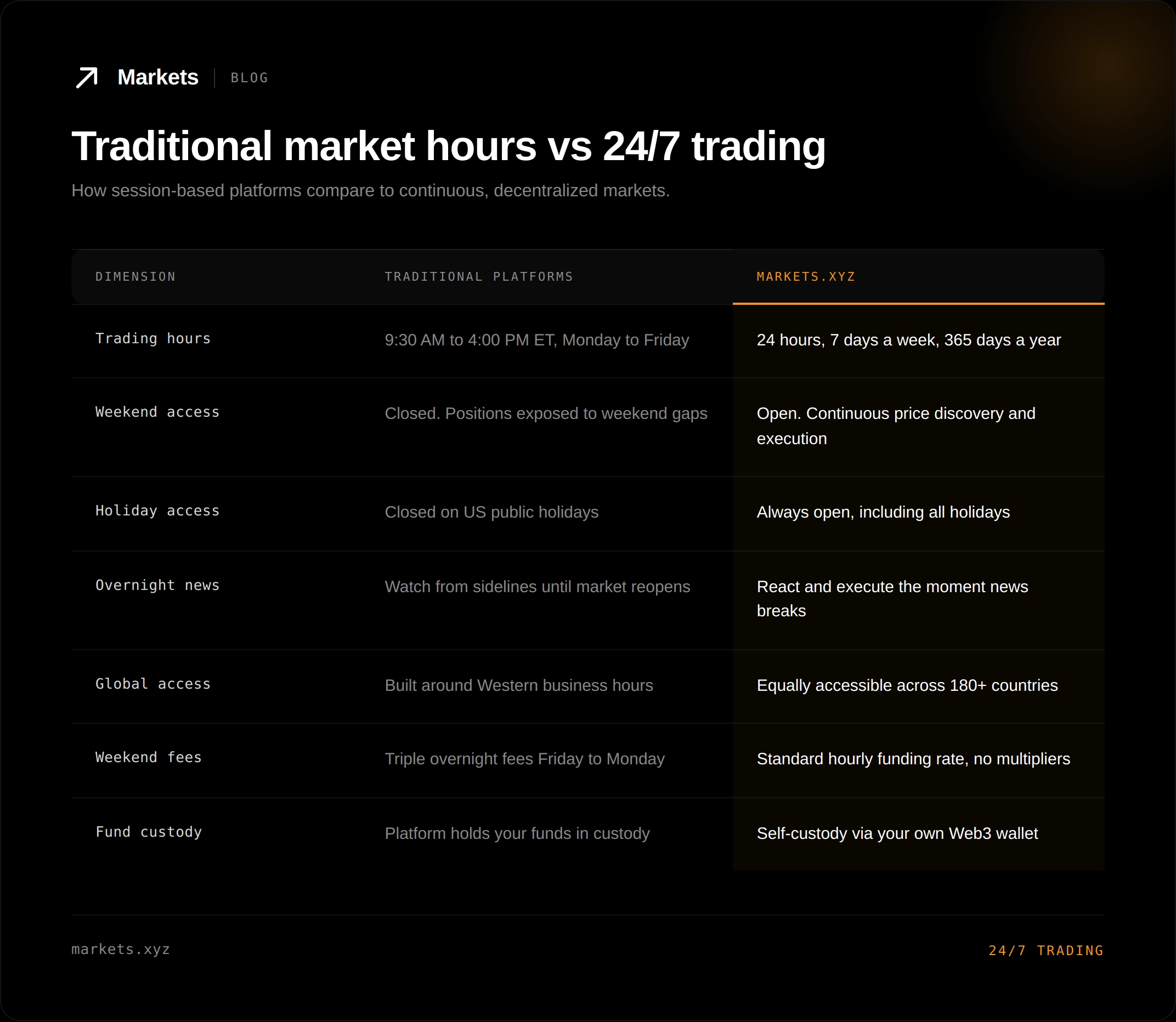
Traditional markets are session-based for historical reasons, not technical ones. Stock exchanges built their hours around the physical trading floor, the business day of a single time zone, and the operational realities of clearinghouses that needed to reconcile trades overnight. None of those constraints exist today. Settlement can be instant. Order matching can be continuous. Liquidity can be global. The 6.5-hour US trading window is a legacy, not a necessity.
Crypto markets were the first to break this mold at scale. Bitcoin trades 24/7 because the protocol that settles it runs 24/7. There is no closing bell, no market maker who needs to go home, no clearinghouse that needs to batch trades overnight. The infrastructure simply doesn't require business hours, so it doesn't have any.
The next evolution is bringing the same continuous access to more asset classes. Equities, indices, commodities, and FX can now be made tradable through on-chain infrastructure, with self-custody and 24/7 market availability. That is what the new generation of decentralized trading infrastructure is enabling, and Markets.xyz is building one of the clearest product layers for it.
Before we get to the advantages, here's what the shift looks like in practice:
The seven advantages of 24/7 trading
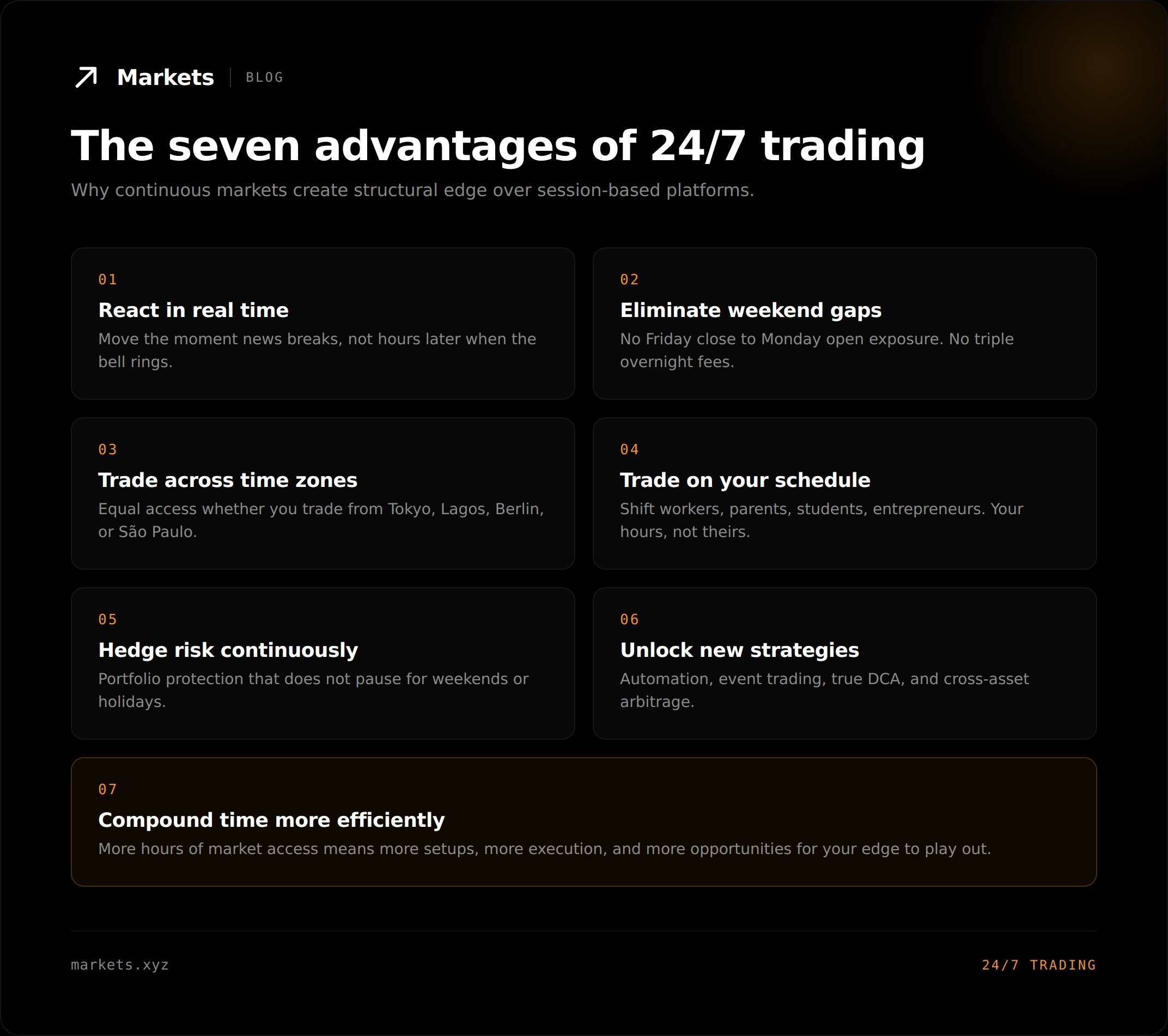
When you remove the artificial constraints of session-based markets, you do not just get more hours. You unlock a set of structural advantages that compound on each other. Some are obvious, like being able to react to news in real time. Others are subtler, like reducing weekend gap risk or unlocking strategy categories that are difficult to run on session-based platforms. Here are the seven that matter most.
1. You react to news the moment it breaks
Markets move on information. The faster you can act on new information, the more value you can capture or protect. Traditional platforms enforce a delay between when news breaks and when you can do anything about it, sometimes measured in minutes, sometimes in days. That delay is pure opportunity cost.
Consider what happened during recent surprise rate decisions, ETF approvals, or major geopolitical announcements. The first hours after the news broke were where most of the move happened. Traders who could act immediately captured the move. Traders waiting for their platform to open watched it on a chart the next morning.
On a 24/7 platform, the gap between information and action collapses. The market reacts. You react. You're not standing outside the building waiting for someone to unlock the door.
This compounds across an entire trading career. A trader who can act on news in real time over ten years has executed thousands of trades around catalysts that a session-bound trader watched go by. The frequency matters as much as the magnitude of any individual move.
2. You stop losing capital to weekend gaps
Weekend gaps are one of the most underappreciated risks in traditional trading. If you hold a position from Friday close to Monday open, anything that happens in those 65 hours plays out without you. A news event on Saturday morning that moves your asset 5% is a 5% gap on Monday's open. You can't exit, you can't hedge, you can't do anything until the platform reopens. And if the move is against you, the loss is locked in by the time you can act.
Traditional platforms compound this with weekend fees. Many brokers triple overnight financing charges from Friday to Monday to compensate for the closed weekend. You pay more, for less control, for longer exposure to events you cannot trade around.
Continuous markets change this structurally. There is no Friday close in the same way because the market remains accessible. Weekend events become tradable rather than something you can only react to on Monday. Funding can run continuously instead of being bundled into weekend multipliers. You still need to manage liquidity, spreads, and volatility, but you are not locked out by the calendar.
3. You capture opportunity across global time zones
The traditional US market open at 9:30 AM Eastern is the middle of the night in Tokyo, late afternoon in London, evening in Dubai, and dawn in Sydney. Building a global financial system around Western business hours means most of the world trades at the wrong time of day, or doesn't trade at all.
24/7 trading restores symmetry. A trader in Lagos has the same access as a trader in New York. The opening of Asian session no longer means North American traders miss the action. The London-New York overlap is no longer the only window where serious liquidity exists. Markets become genuinely global, not just nominally global.
This matters for liquidity as much as for fairness. When traders from every region can participate at any hour, order books deepen, spreads tighten, and price discovery becomes more efficient across every session, not just during Western business hours.
4. You trade on your own schedule
Most people who want to trade have jobs, families, and lives. The 9:30 AM to 4:00 PM Eastern window is nearly perfectly designed to exclude anyone working a normal day shift in any time zone. Lunch break on the East Coast is the only real overlap, and that's not when meaningful research, planning, or position management gets done.
Shift workers, healthcare staff, parents managing childcare, students, entrepreneurs juggling multiple commitments, freelancers, and side-hustle traders all share the same problem on traditional platforms: their available hours don't overlap with the platform's available hours.
24/7 access changes the equation. You trade when you have time to trade. Early morning before work. Late evening after the kids are asleep. Saturday afternoon. Sunday morning. The platform fits your life rather than forcing your life to fit the platform.
5. You can hedge risk continuously
Risk management depends on the ability to act. If you hold a large equities position and a major macro shock happens overnight, you want to be able to hedge that exposure immediately, not wait for the market to open and find out what your position is worth at the new price. Continuous trading makes continuous hedging possible.
This is particularly important for portfolio managers and serious individual traders who hold significant positions across asset classes. A weekend event that affects oil prices, currency rates, or geopolitical risk premium can ripple through a portfolio in ways that are impossible to address until the next session begins. Or, on a 24/7 platform, addressed in the same hour the event happens.
Hedging is not just an institutional concern. Anyone managing meaningful exposure across multiple positions benefits from the ability to adjust risk continuously, not just during a six-and-a-half hour window five days a week.
6. You unlock new strategy categories
Some strategies simply cannot exist on session-based platforms. Algorithmic trading benefits enormously from continuous markets, since strategies can execute around the clock with no idle windows. News-based event trading depends on the ability to position the instant news breaks, not the next morning. True dollar-cost averaging means buying a fixed amount at fixed intervals regardless of what day or hour it is, not whenever the market happens to be open.
Cross-asset arbitrage becomes much more practical when all the assets you're arbitraging are accessible at all times. Statistical strategies that look for small edges across many trades benefit from the increased volume of executions that 24/7 access enables. And automated portfolio rebalancing can run continuously, not just during business hours.
These aren't theoretical. Each of these strategy categories already exists in crypto markets, where 24/7 has been the default for over a decade. As continuous access expands into other asset classes, these strategies expand with it.
7. You compound time more efficiently
Active traders depend on the volume of trading opportunities. A small edge compounded over many trades produces real returns. A small edge compounded over fewer trades produces fewer returns. Time spent unable to trade is, mathematically, time spent unable to compound.
The 9:30 AM to 4:00 PM Eastern window represents 32.5 hours per week, or about 19% of the 168 hours in a full week. A trader on a 24/7 platform has access to roughly 5.2 times the trading hours of one on a standard US session-based platform. Even if only a fraction of those extra hours produce viable setups, the difference in lifetime opportunity set is substantial.
For passive traders, the same principle applies in reverse. Continuous settlement and continuous access means your strategy can rebalance, hedge, or adjust whenever conditions warrant it, not whenever the calendar happens to permit it.
Stop waiting for the bell. Markets are open right now. Start trading on markets.xyz.
Who benefits most from 24/7 trading
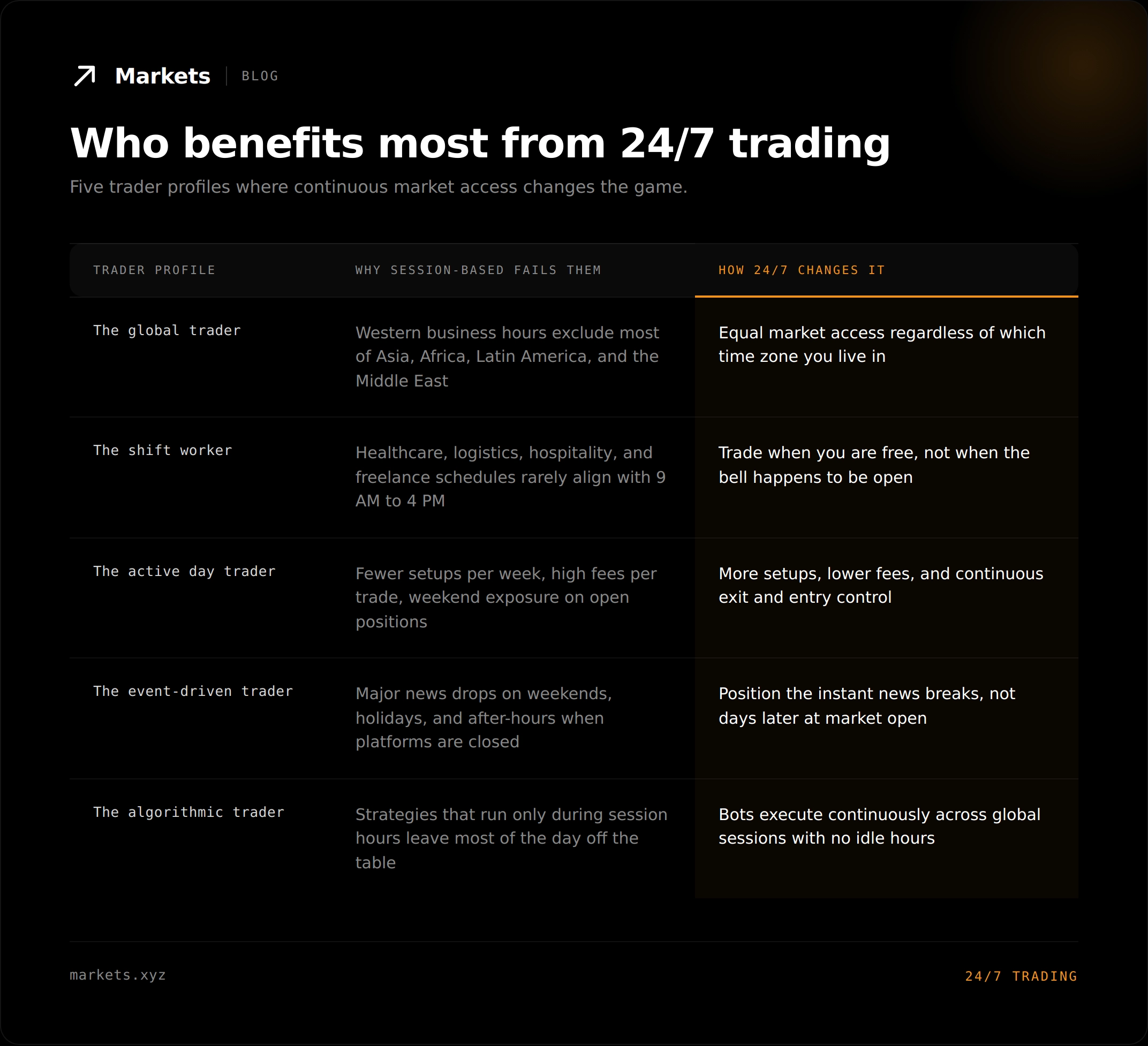
24/7 trading is an advantage for every type of trader, but for some it's a complete change in what's possible. These are the five profiles where continuous access fundamentally rewires how trading works, not just at the margin but at the foundation.
The global trader outside Western business hours
If you live in Asia, Africa, Latin America, or most of the Middle East, traditional Western trading hours fall in the middle of your night. The US open at 9:30 AM Eastern is 10:30 PM in Singapore, 2:30 AM in Dubai, and 11:30 PM in São Paulo. Trading during those hours means sacrificing sleep, missing family time, or compromising your ability to function the next day.
Continuous markets restore parity. A Mumbai-based trader can act on Indian market news at the moment it breaks. A Lagos-based trader can position around African macro events as they happen. The infrastructure stops being a geographic accident and starts being genuinely global.
The shift worker and non-traditional schedule trader
Nurses, paramedics, pilots, factory workers, restaurant staff, freelancers, creative professionals, and anyone running a small business on the side. Their available hours rarely align with the 9:30 AM to 4:00 PM Eastern window. On traditional platforms, that means trading happens before the day starts or after it ends, in narrow margins of exhaustion.
24/7 access flips this. There's no wrong time to check positions, place trades, or review charts. The platform fits the trader's life. For people with non-traditional schedules, this is the difference between trading being an actual practice and trading being an aspirational hobby they never quite get to.
The active day trader
Active traders are limited by setup frequency, fee structure, and weekend exposure. Each one of these tightens or relaxes with 24/7 access. More trading hours means more setups per week, more opportunities to put a tested strategy to work. Lower per-trade fees, which decentralized platforms generally offer, make smaller setups economically viable. And the ability to manage positions continuously eliminates the Friday-to-Monday gap risk that quietly erodes many active traders' returns over time.
For someone whose income or P&L meaningfully depends on trading activity, the move from a session-based platform to a 24/7 platform isn't an upgrade. It's an entirely different operating environment.
The macro and event-driven trader
Event-driven traders make their money positioning around specific catalysts: earnings releases, central bank decisions, regulatory announcements, geopolitical events. The defining characteristic of these catalysts is that they don't respect market hours. Earnings drop after the close. Central banks announce on Sunday evenings. Geopolitical news breaks at 3:00 AM.
On a session-based platform, the event-driven trader is structurally disadvantaged. By the time the market opens, the move has already happened and the entry has become exit. On a 24/7 platform, the event-driven trader can position at the moment of the catalyst, which is the only moment that actually matters for that strategy.
The algorithmic trader
Automated strategies depend on continuous market access to function. A bot that runs only during US business hours leaves more than two-thirds of the week unused. A bot that runs continuously across 24/7 markets is operating at the maximum capacity its strategy allows.
Decentralized 24/7 platforms also tend to offer cleaner API access, programmable smart contract execution, and on-chain settlement that aligns naturally with automated workflows. For traders who design, run, or rent trading bots, the combination of continuous markets and Web3-native infrastructure is a meaningful upgrade over what session-based platforms can provide.
Real-world scenarios where 24/7 access wins
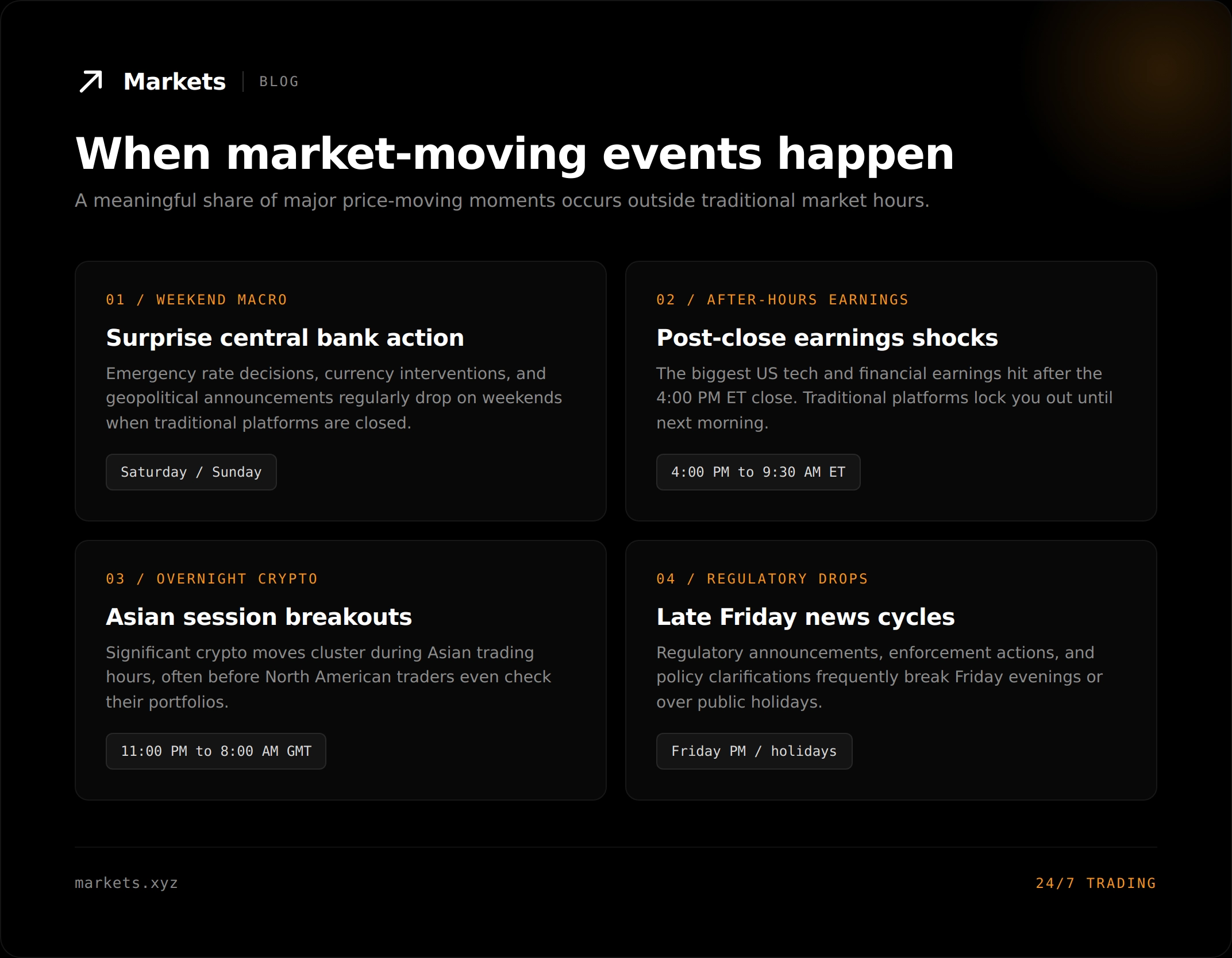
The advantages of 24/7 trading are clearest when you look at specific situations where being able to act matters more than being able to wait. These aren't hypothetical. Each one of these scenarios plays out multiple times a year, and on session-based platforms, traders are simply locked out of them.
Weekend macro events
Major macro events cluster on weekends with surprising frequency. Emergency central bank meetings, currency interventions, sovereign debt announcements, and political events have a habit of landing on Saturdays and Sundays, often specifically because policymakers want markets closed when they announce. The result is a Monday gap where prices have already moved by the time anyone can trade them.
On a 24/7 platform, that gap doesn't exist. The news breaks, the market reprices in real time, and you participate in the move as it happens. Your entry isn't a Monday morning chart you watched form over the weekend, it's an actual position you put on while the move was developing.
After-hours earnings shocks
Major US earnings drop after the 4:00 PM Eastern close. The biggest names in tech, finance, and consumer report after the bell, and the price reaction often happens within the first hour. By 5:00 PM, the move is largely done. Traditional platforms typically reopen at 9:30 AM the next morning, by which time the trader is no longer reacting to news but trading against people who already did.
24/7 platforms with equity-linked markets give you the ability to position around the earnings reaction when the news drops, instead of waiting for the next regular session. The asymmetry between session-based and continuous access is sharpest in this exact scenario.
Overnight crypto moves
Crypto markets have been 24/7 since their inception, and a real share of meaningful price action happens during Asian trading hours. A North American trader who sleeps through Asian session is sleeping through some of the most active hours of the week. On a 24/7 platform with global participation, Asian session is just another part of the trading day, not a black box that happens while you're asleep.
This applies to traders in every region, not just the Americas. A European trader who only participates during European hours is similarly missing the Asian and US sessions. 24/7 access doesn't mean trading every hour. It means having the choice.
Geopolitical and regulatory breaks
Geopolitical events, war news, regulatory enforcement actions, and policy announcements have a strong tendency to break late Friday, over weekends, or during holiday windows. This is partly intentional, since regulators often want markets to have time to absorb news before reopening, and partly circumstantial, since these events follow their own timelines.
For traders on session-based platforms, this means structural exposure to events they cannot trade around. For traders on 24/7 platforms, it means those events become tradable. The catalyst becomes an opportunity instead of a risk you can only hope to survive until Monday morning.
Pre-market and after-hours momentum continuation
Major moves don't usually happen in a single session. A significant catalyst in after-hours often triggers continuation moves overnight as Asian and European traders react, then again at the regular open as Western retail and institutional flow joins in. Session-based platforms force you to choose: either trade the initial after-hours move with limited liquidity, or wait for the open and miss the overnight portion entirely.
Continuous platforms let you participate at every stage of the move. You can scale in during after-hours when the catalyst lands, ride the overnight continuation, and exit or add at the open with full visibility into how the move developed. The trade becomes one fluid execution instead of three fragmented windows.
The next major move won't wait for the bell. Start trading on markets.xyz.
The opportunity cost of session-bound trading
It's easy to think of session-based trading as the default and 24/7 trading as the upgrade, but it's more accurate to think of session-based trading as an active cost. Every hour the platform is closed while markets are moving is an hour of opportunity cost. That cost compounds across a trading career in ways that are hard to see in any single week, but very visible in a decade.
A rough framework: traditional US market hours represent 32.5 hours of active trading per week, or about 19% of the 168 hours in a week. Even accounting for the fact that not every closed hour produces tradable moves, the share of meaningful market activity that happens outside regular session hours is substantial. Weekend macro, after-hours earnings, overnight crypto, and global session activity all sit outside the standard trading window.
That's a meaningful share of the opportunity set sitting outside what a session-based trader can access. Over a year, the difference between a trader who can act on all those moments and a trader who can only react after they're already priced in is significant. Over a decade, it's the difference between two entirely different trading careers.
There's also a hidden tax that session-based platforms charge: the weekend fee multiplier. Many traditional brokers charge triple overnight financing from Friday to Monday. Hold a leveraged position for the full year, and those weekend multipliers add up. On a 24/7 platform with a single continuous funding rate, that tax disappears.
Think of it this way. A session-based trader and a 24/7 trader can run the same strategy with the same edge and the same risk management, and the 24/7 trader will still come out ahead over time. Not because their edge is bigger, but because they get to apply it across more opportunities, without losing capital to weekend gaps, without paying fee multipliers, and without watching catalyst moves play out from the sidelines. The platform itself is part of the edge.
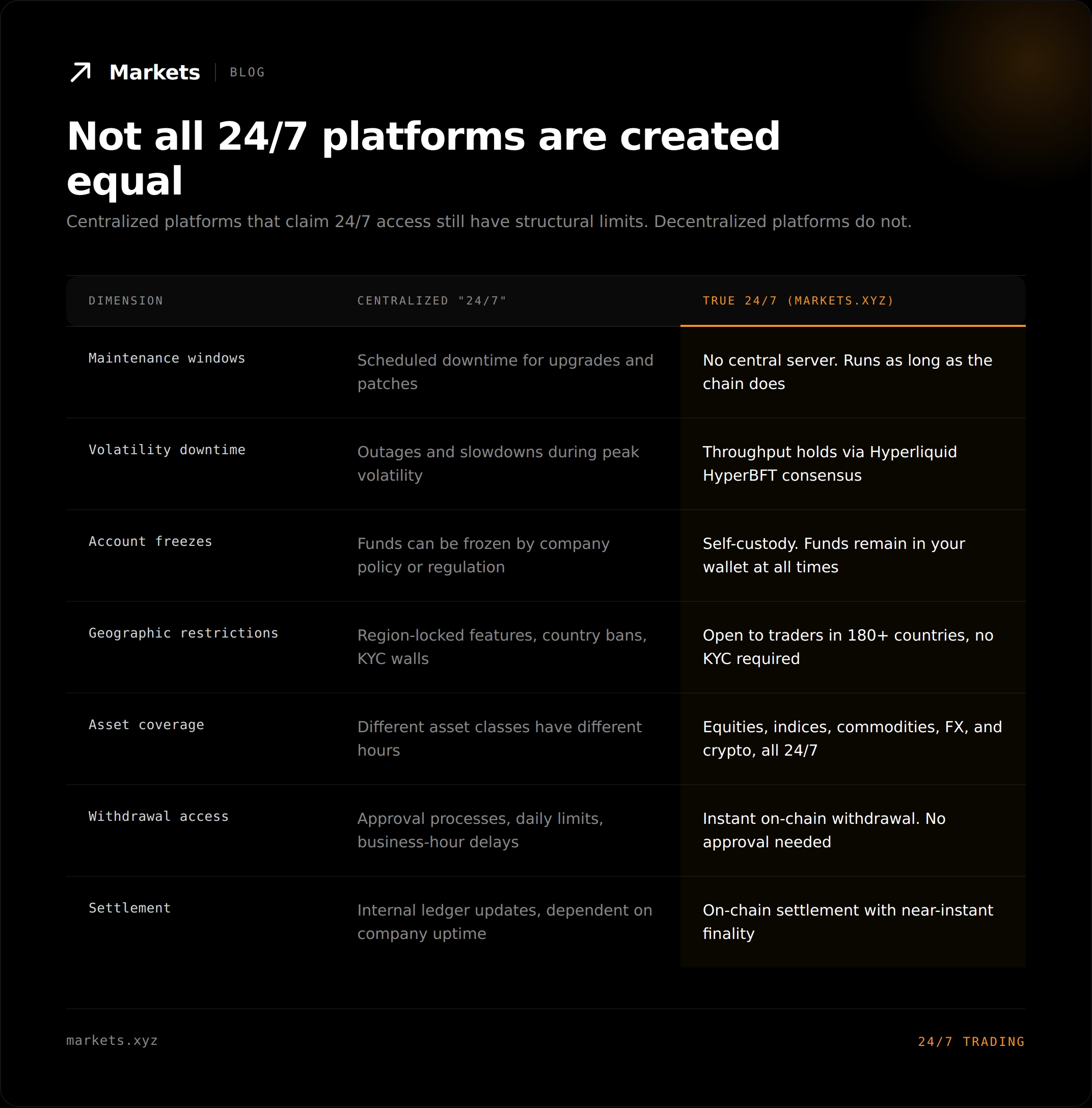
Not all "24/7" platforms are created equal
The phrase 24/7 has become marketing language, and the gap between what is claimed and what is actually delivered varies significantly between platforms. Before assuming that any platform calling itself 24/7 actually provides continuous access, it is worth understanding the structural difference between centralized platforms with exchange-operated maintenance windows and decentralized infrastructure whose availability depends on the underlying chain, validators, interfaces, and supporting systems.
Centralized exchange outages
Even the largest centralized crypto exchanges have a long history of outages during periods of high volatility. Trading is paused for maintenance, withdrawals are temporarily suspended, or the entire platform becomes unresponsive during exactly the moments when traders need access most. These aren't edge cases. They've happened repeatedly across every major centralized exchange, and they'll keep happening because the underlying architecture has single points of failure.
Centralized platforms also schedule planned maintenance windows. The platform is closed at the time the team chooses. Even if those windows are short, they break the 24/7 promise. Genuinely continuous trading cannot have scheduled downtime.
Regional restrictions and gated access
Many platforms that advertise 24/7 trading still restrict access by country, by asset class, or by user verification status. Some assets are only available to users in certain jurisdictions. Some features are gated behind KYC tiers that take days to clear. A platform that is 24/7 in theory but unavailable to half the world in practice is not actually providing continuous global access.
True continuous markets
Genuinely 24/7 trading requires infrastructure that doesn't depend on the uptime of any single company. Decentralized platforms built on blockchain infrastructure inherit the uptime of the underlying chain, which for well-established networks means functionally continuous availability. There is no central server to fail, no company to schedule maintenance, no approval process to delay execution.
True continuous markets also depend on continuous price discovery, which requires oracle infrastructure and pricing models that can support trading outside regular market hours. Markets.xyz uses Kaiko-powered pricing for traditional assets, helping provide tradable reference prices for equities, indices, commodities, and FX even when underlying venues are closed.
How Markets.xyz delivers genuine 24/7 trading
Markets.xyz brings together a trading terminal, mobile trading app, and HIP-3 deployer built on Hyperliquid infrastructure. Hyperliquid provides the trading-specific Layer 1, on-chain order-book infrastructure, and fast settlement layer. HIP-3 allows deployers like Markets to launch and operate new perpetual markets on top of that infrastructure.
For traders, that means access to supported markets through a product layer designed for continuous trading. Markets gives users a single interface for trading crypto, equities, indices, commodities, and FX markets where supported, while the underlying execution and settlement happen through Hyperliquid infrastructure.
Pricing for traditional assets is supported by Kaiko-powered data, helping provide reference prices for equities, indices, commodities, and FX outside regular market hours. Crypto markets already operate continuously, and Markets brings that same always-available trading experience into a broader multi-asset environment.
Access is available across supported jurisdictions, with no KYC required where Markets.xyz is available. The model is self-custodial rather than exchange-custodial: users do not trade through a traditional centralized exchange account or wait for an exchange operator to approve withdrawals. Depending on the market and trade type, collateral may interact with smart contracts or protocol-level trading accounts, but the custody model remains structurally different from a CEX.
You can see the model in action through supported 24/7 markets such as US500 and crypto perpetuals. Liquidity, spreads, and pricing can still vary by asset and session, but the platform is designed around continuous access rather than traditional market hours.
Fees are designed to be transparent and predictable, with no weekend multiplier structure. Funding rates run on a regular schedule, which makes the cost of holding leveraged positions easier to model and compare. Withdrawals are handled through on-chain infrastructure rather than a traditional exchange withdrawal desk.
Trade every market, every hour. Start trading on markets.xyz.
The discipline side: trading in an always-on market
24/7 access amplifies opportunity, but it also amplifies behavioral risk. When the market is always open, the temptation to always be in a position is real. Traders who do well on continuous platforms tend to be the ones who treat the additional access as optionality rather than obligation. They use the hours when they have edge, and they ignore the hours when they don't.
The overtrading trap is the most common failure mode. More hours of access doesn't mean more hours of good setups. A trader who would have taken three setups per week on a session-based platform doesn't suddenly have nine setups per week on a 24/7 platform. They have the same edge, distributed across more hours. Trading more frequently without more edge is a guaranteed way to underperform.
Setting personal trading hours is a useful discipline. Pick the hours when your edge is sharpest, when you're most focused, and when the asset classes you trade are most active. Trade those hours. Ignore the rest. The platform being open at 4:00 AM does not mean you need to be.
Sleep and recovery matter. Decision quality declines sharply with fatigue. A trader who burns out attempting to trade every Asian session has shortened their career, not extended it. The best traders, regardless of platform, take real time off.
Position sizing also deserves a second look in always-on markets. Because you can adjust positions at any hour, it's tempting to run larger size than you would on a session-based platform, assuming you'll always be available to manage it. That assumption is wrong. You'll sleep. You'll have meetings. You'll go to dinner. Position sizing should be set so that a position you can't watch for several hours still doesn't put your portfolio at risk.
Discipline check: 24/7 access is a tool, not a mandate. The traders who win on continuous platforms are the ones who treat the extra hours as optional, not obligatory. Pick your hours, stick to your edge, and remember that the market being open is never a reason to take a trade.
Frequently asked questions
Some of the most common questions we hear about 24/7 trading, answered clearly and without the marketing gloss.
Is 24/7 trading actually safer or riskier than session-based trading? Neither, structurally. The asset and strategy determine risk, not the platform hours. What 24/7 trading does change is your ability to manage that risk. You can hedge, exit, or adjust at any hour, which usually makes risk management easier rather than harder.
Do I have to trade at night to benefit from a 24/7 platform? No. Most traders on 24/7 platforms still trade during their personal waking hours. The benefit isn't trading more, it's having the choice to trade when you need to, whether that's a Sunday morning macro event or a Tuesday after-hours earnings reaction.
Why don't traditional brokers offer 24/7 trading on stocks? Traditional brokers depend on the underlying exchange being open to source liquidity. Without continuous oracle pricing or a decentralized matching engine, they can't offer fair pricing on equities outside exchange hours. Decentralized platforms with continuous oracles solve this structurally.
What happens to my open positions during weekends on Markets.xyz? Positions remain open and tradable. Funding rates accrue at the standard hourly rate, with no weekend multipliers. You can exit, adjust, or hedge at any time. There is no Monday gap risk because there is no Friday close.
Do funding rates work differently on a 24/7 platform vs traditional weekend overnight fees? Yes. Traditional brokers often triple overnight financing from Friday to Monday to compensate for the closed weekend. 24/7 platforms charge a single continuous funding rate that does not change based on the day of the week. The cost of holding a leveraged position over a weekend is materially lower.
Can I use 24/7 access for portfolio hedging, or only for active trading? Both. Hedging benefits from continuous access at least as much as active trading. The ability to put on a hedge the moment a portfolio risk emerges, rather than waiting for the next market open, is one of the strongest use cases for 24/7 platforms.
Is liquidity actually available at 3 AM on a Sunday? Yes, though it varies by asset. Crypto perpetuals have deep liquidity around the clock. Major equities and indices on Markets.xyz have continuous oracle pricing and growing depth even during off-peak hours. Liquidity in continuous markets follows demand, and demand is genuinely global.
Is Markets.xyz available in my country? Markets.xyz is available in 180+ countries. The platform is not available to users in the United States, the United Kingdom, or Ontario, Canada. Full geographic restrictions are detailed in our terms of service.
Conclusion
Markets exist to price the world. The world doesn't operate on a 9:30 AM to 4:00 PM Eastern schedule, so markets shouldn't either. 24/7 trading isn't a feature that traditional platforms have failed to add. It's a structural shift that decentralized infrastructure makes possible and that traders are increasingly demanding.
The advantages are concrete. Faster reaction to news. Reduced weekend gap risk. Global access across time zones. The ability to trade on your own schedule. Continuous hedging. New strategy categories. More efficient use of trading time. Each one of those can create real edge over session-based platforms when paired with discipline and risk management.
The next opportunity is happening right now. Somewhere in the world, someone is trading it. The only question is whether your platform lets you be one of them.
Markets don't sleep. Neither does your edge. Start trading on markets.xyz.
Risk disclaimer: Trading involves substantial risk, including the possible loss of principal. Leverage amplifies both gains and losses. Past performance is not indicative of future results. Markets.xyz is not available to residents of the United States, the United Kingdom, or the province of Ontario in Canada. Full terms, conditions, and risk disclosures are available at markets.xyz. Information in this article is for educational purposes only and does not constitute financial, investment, or trading advice.