

Learn about trading
Last updated
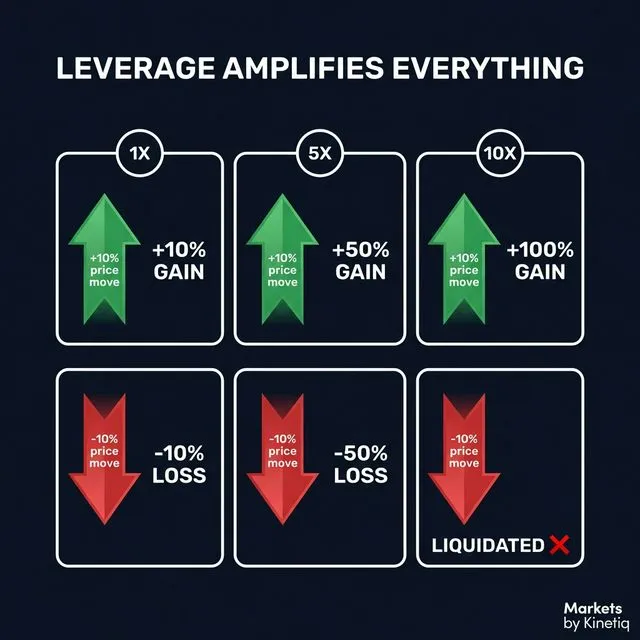
Leverage lets you control a larger position than your actual deposit. It amplifies gains — and losses — by the same multiple. Liquidation is what happens when those losses exceed your deposit.
This page covers both clearly, so you can trade with eyes wide open.
What is leverage?
When you trade at 1× leverage (no leverage), your position moves 1-to-1 with the asset price. You deposit $100, you control $100 worth of TSLA. If TSLA goes up 10%, you make $10.
With 10× leverage, your $100 deposit controls a $1,000 position. If TSLA goes up 10%, you make $100 — doubling your deposit. But if TSLA goes down 10%, you lose your entire $100 deposit.
Leverage is a multiplier on both sides.
Leverage examples
Long NVDA at $800 — $500 deposit
Leverage | Position size | NVDA +10% = $880 | NVDA -10% = $720 |
|---|---|---|---|
1× | $500 | +$50 (+10%) | -$50 (-10%) |
3× | $1,500 | +$150 (+30%) | -$150 (-30%) |
5× | $2,500 | +$250 (+50%) | -$250 (-50%) |
10× | $5,000 | +$500 (+100%) | Liquidated ❌ |
At 10×, a 10% move against you = 100% of your deposit gone. The position is automatically closed.
What is liquidation?
Liquidation is the automatic closure of your position when your losses have consumed your margin (your deposit).
Markets closes the position automatically to prevent you from going into negative balance. Think of it as a forced stop-loss at zero.
Why it exists
Without liquidation, a losing position could theoretically owe more money than you deposited. Liquidation caps your downside at your deposit.
Your liquidation price
Before opening any trade, you should check your liquidation price — the exact price level at which your position would be closed.
Example:
You go Long TSLA at $800 with $500 deposit at 5× leverage.\Your position size: $2,500.\A 20% move against you (-$500) wipes your deposit.\Liquidation price ≈ $800 × (1 - 0.20) = ~$640
Markets shows your liquidation price on every open position. Check it before you click confirm.
Isolated margin vs cross margin
Markets uses Isolated margin by default — the safest approach.
| Isolated margin | Cross margin |
|---|---|---|
What's at risk | Only that position's deposit | Your entire account balance |
Liquidation affects | Just that trade | Could wipe your whole account |
Best for | Beginners and most traders | Advanced multi-position strategies |
✅ Recommendation: Use isolated margin while learning. It limits your maximum loss to what you put into that specific trade.
Leverage risk guide
Leverage | Risk level | Who it's for |
|---|---|---|
1× | ⬜ Minimal | First trade, learning the platform |
2×–3× | 🟡 Low-Moderate | Confident directional traders |
5× | 🟠 Moderate | Experienced traders with clear thesis |
10×+ | 🔴 High | Short-term scalpers who monitor closely |
For most traders, 2×–5× is the practical range. 10×+ is for experienced traders who are watching positions closely.
The safeguards: use all of them
1. Set a stop loss
A Stop Loss automatically closes your position if price reaches a level you define — before you hit liquidation. This limits your loss to a number you're comfortable with.
2. Know your liquidation price
Always visible on your open position. If the current price is close to your liquidation price, consider closing or adding margin.
3. Size positions appropriately
A common rule: never risk more than 1–2% of your total account on a single trade. If you have $1,000, that's $10–20 per trade.
4. Use isolated margin
Keeps each trade's risk contained. One bad trade can't cascade into your whole account.
Warning signs you're over-leveraged
- Your liquidation price is less than 5% away from the current price
- A single news headline could wipe your position
- You're checking the price every 10 minutes out of anxiety
- You've increased leverage to "recover" a losing position
On this page